


For example, after being burned down several times, the current Taihe Dian was rebuilt in 1695. Its 64-m-wide facade may look magnificent to the layman, but many professional researchers consider its size is not proportionate to its status.
Compared with the scale of the outer gates at the Forbidden City and the main ceremonial hall at Emperor Yongle's mausoleum, Taihe Dian is thought to have been larger than it appears today.
But how much larger was it?
According to Ming Shilu (Veritable Records of the Ming)-comprehensive imperial annuals written by historians during the dynasty-the facade of the hall was originally 95 m wide, or 30 zhang in traditional Chinese measurement, before it was again destroyed by fire in 1557.
Based on Taihe Dian's current structure, this means that the two columns in the central hall were more than 14 m apart, surpassing all surviving ancient Chinese architecture.
Xu said: "We used to think such a super size was hardly possible. Maybe '30 zhang' was just an abstract expression to describe its grandeur, but the ongoing archaeological work has given us second thoughts on just how large the early Ming palaces were."
For instance, the four unearthed column footings show there was space for a room of about 120 sq m. A later excavation of the outer wall foundations indicated that this room was located at the eastern end of a palace.
Wu said: "It may have been even larger in the center. We'll continue our excavations to look for more columns and thus accurately estimate the size of this 'underground palace'."
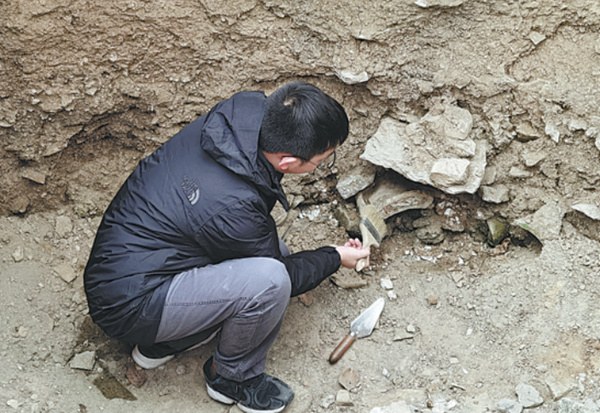
An exceptionally cautious approach has been adopted to archaeology at the Forbidden City. Once a layer of architectural remains is found, archaeologists immediately stop digging deeper and scrutinize the foundations. However, protecting this heritage and studying its inner structure posed a challenge.
Xu's team was fortunate. One of the column footings had cracked, providing an opportunity for an in-depth study of how the foundations were constructed.
Along with the column footings, brick-paved ground surfaces from the middle and later periods of the Ming Dynasty have been unearthed at the site, indicating a continuous lineage of evolving construction in this area.
"We can literally trace back 600 years with just a glance," Xu said.





