



Cultural protection helps Tibetans make better living









The Tibet autonomous region achieved remarkable results in passing on and protecting traditional culture last year, according to a cultural work conference held recently in the regional capital, Lhasa.
Last year, Tibet added 17 national intangible cultural heritage representative projects and launched its first batch of regional-level cultural and ecological reserve work.
Xiao Chuanjiang, deputy head of the regional cultural department, said that Tibet made progress in the protection and use of ancient books and documents housed at the Potala Palace, including finishing a general survey of 4,500 ancient books, restoring 21,900 pages in damaged books, and converting 350 ancient books into e-books for public use.
"At the same time, we finished investigations into 277 grotto temples and cliff paintings, and 23 archaeological excavation projects were carried out," Xiao said.
"Among the excavations, the discovery of the Sangsdar Lungmgo grave site in Ngari prefecture ranked as one of China's top 10 new archaeological finds of the year, and the Damshung cemetery site in Damshung county was selected as one of the top 10 discoveries last year," he added.
"Last year, we also finalized the scope of protection and control of construction at 15 national and 518 regional protected cultural heritage sites."
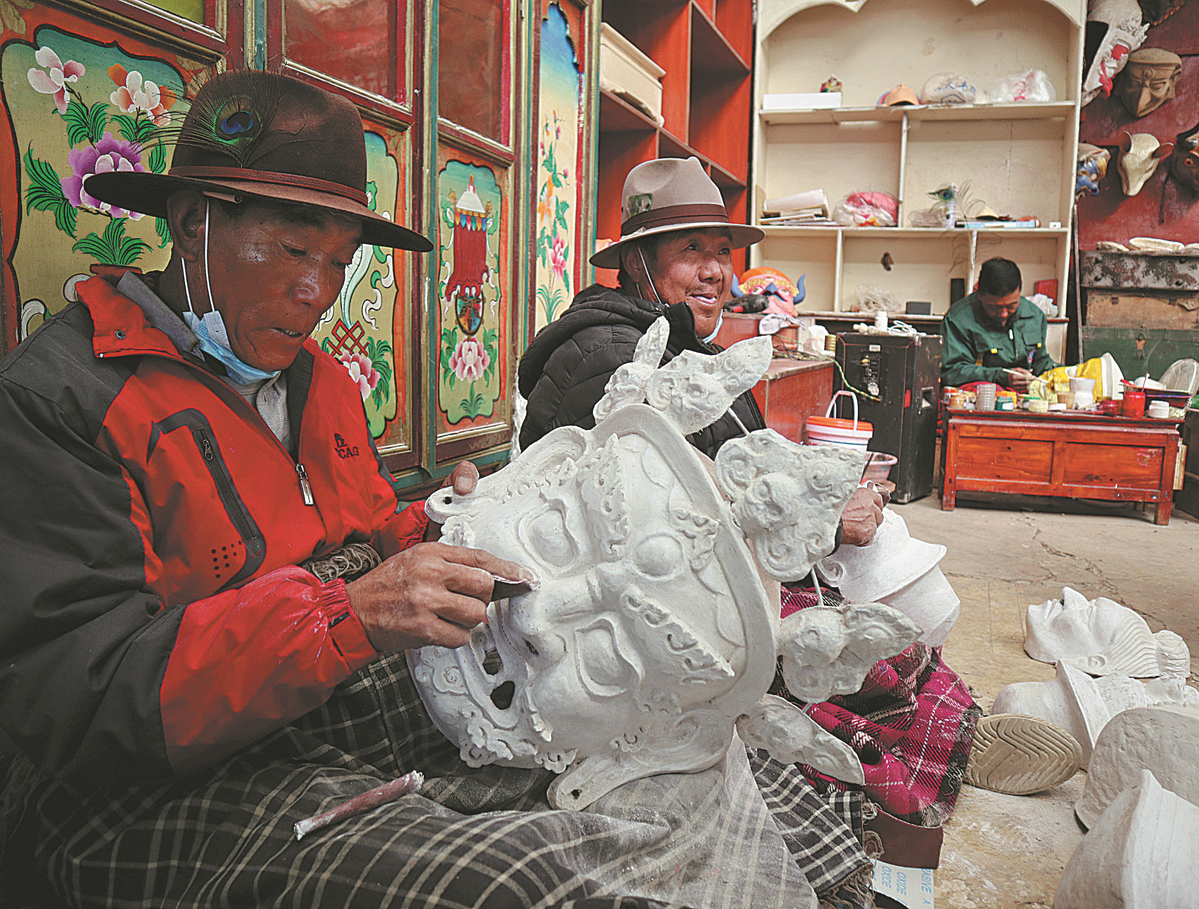
Many residents benefit directly from governmental efforts to protect and pass on traditional culture. Last year, more than 3,000 found jobs at 120 intangible cultural workshops, earning an average monthly salary of around 3,000 yuan ($470).
In Zangkha village in Panam county, village Party secretary Palyang said that 65 villagers from 90 households have invested in a weaving cooperative, three of them disabled.
"Our workshop produces woven Tibetan handicrafts, including carpets, thick wool garments and traditional women's aprons," Palyang said, adding that the villagers make annual incomes of between 20,000 and 90,000 yuan at the workshop.
In 2016, the weaving workshop was selected to be a county center for vocational skill training.
Zangkha resident Wangyal, has worked at the collective for several years. He said that as he and his mother suffer from poor health, learning to weave has contributed to the family income.
"Now, I can have a monthly salary of 6,000 yuan. I have bought a new TV and a washing machine, and my life has become better," he said.
According to Xiao, the region will continue to encourage businesses to develop cultural products this year.
"This year, through cultural heritage protection, Tibet will launch the second round of a regionwide survey and embark on the digitalization of intangible cultural heritage resources," he said.


















