


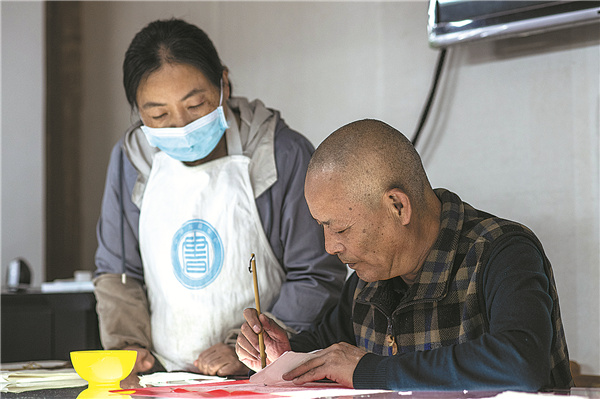
Gently removing the upper and lower layers of the hardwood cover, Yang Liqun takes out a sheet of paper that has been repaired. The original gap in the ancient manuscript has been filled, with its former softness restored.
"Made of bark and archived in caves for long periods, many ancient books in the ethnic Yi language can easily be damaged," says Yang, a 64-year-old restorer from the Yunnan Ancient Books Preservation Center.
In March, Yang's team launched a project to salvage the severely damaged five ancient brochures of Cham, the creation epic of the Yi ethnic group.
Famous for their embroidery and torch festival, the Yi people mainly live in Southwest China, with a total population of around 9.8 million in 2020, according to the 2021 China Statistical Yearbook.
Yang says the restored books should retain their original appearance, and the restoration process should be reversible, meaning any repair materials can be removed easily if necessary.
The restoration procedure requires the preparation of original or similar materials, patching, uncurling, reshaping pages and binding. Based on the specific condition of the damaged parts, restorers will come up with an appropriate plan on a case-by-case basis.
Southwest China's Yunnan is home to more than a million ancient books written in the languages of various ethnic groups, with many of the texts scattered among communities and in need of repair.
Books belonging to different ethnic groups served different functions and thus were stored in various conditions, which presented restorers with a range of challenges. As they were used for worship, Yi documents are often burned or greasy, while the pages of ancient Tibetan books have become stuck together due to humidity.
Yang recalled his salvage of the Nagela Cave Tibetan Scripture, an ancient classic of Lamaism. "Mixed with mud, the pages were so messed up that we began with a solid 'brick'," he says.
Located on a cliff around 100 kilometers from Yunnan's Shangri-La, the cave was hidden behind bamboo and thorns. The dozen Tibetan manuscripts that were discovered there in 2010 consisted of more than 2,000 pages.
The ancient books recorded religious rituals and Buddhist classics. The precious documents show the workmanship of Tibetan calligraphy, as well as printing and papermaking processes, says Ji Sicheng, Yang's colleague.
With no similar precedents for the restoration of classics from ethnic minorities, Yang conducted investigations in various parts of China and decided to use the scripture's original material, a poisonous local herb called langducao that repels insects. He mashed the root of the herb and mixed it with pulp before repatching the book.





