


Artist in her natural element









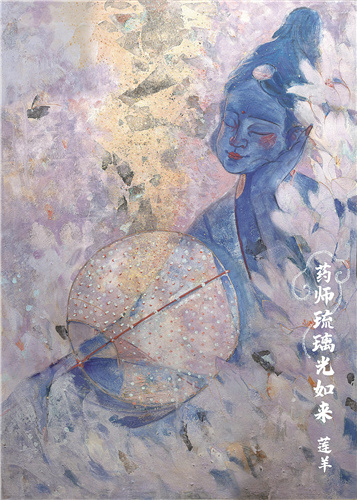
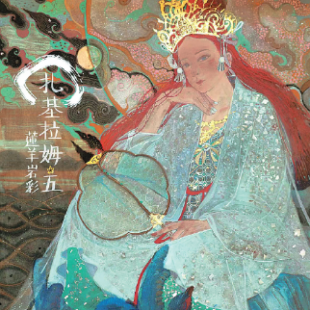
She reveals that the cyan and red are the most expensive pigments, as you can rarely find natural minerals in these colors. Beautiful minerals, such as malachite and lapis lazuli, are highly priced and usually used in jewelry.
Luckily, in recent times, in response to the increasing scarcity or prohibition of natural ores, new materials have been developed as artificial ores are smelted by dissolving glazes and metal oxides. This method has expanded her color pallette from just a few dozen to several thousand.
Also, Wu likes to pick up beautiful stones while enjoying the outdoors, and she's always excited about powdering them and finding out what color they will turn into.
She's now very familiar with the formation conditions of various minerals. For instance, where there are volcanoes there is sulfur and where there are caves there are crystals.
Wu usually draws inspiration from traditional culture, including ancient landscape paintings, books like The Classic of Mountains and Seas and Buddhist sutras. She later traveled around exploring the old art pieces following the path taken by Tang Dynasty monk Xuanzang to Northwest China and Gansu province's Dunhuang. In her eyes, those are the stories worth telling.
Born in Dazhou city, Sichuan province, Wu started drawing when she was around 3 years old. She would use the coloring pens her mother, a teacher, kept to mark homework. She loved to use them to scribble on the walls or her clothes. Wu's open-minded parents never got cross with her for the mess she created, but instead saw her potential, buying her paper and pens of her own so that she could pursue her passion.
Wu later enrolled in Sichuan Fine Art Institute in Chongqing, before going on to study computer graphics at the Central Academy of Fine Arts in Beijing. There she learned important skills, such as how to create art pieces combining ink painting and Photoshop.
After graduating in 2008, Wu worked as clerical administrative staff at the Ministry of Culture in Beijing, but she didn't put down her brushes. She spent her spare time creating illustrations and graphic designs for fun and also taking orders from publishers, game companies and film advertising companies.
Wu quit her job in 2011, when she gradually realized that digital painting might replace hand-drawn art.
She reveals that, for three years, she learned basic skills like sketching, but people now only need to put a photo into some computer software and it can immediately be rendered as an oil painting or watercolor.
"I felt my presence getting weaker," Wu says. However, the feeling of powerlessness didn't tear her apart, but instead strengthened her determination to find an artistic expression that couldn't be replaced so easily by modern technology.