China sets example by blazing green transition trail









Policymakers around the world have been facing a dilemma — how to deliver economic growth and at the same time preserve nature. Countries face the challenge of shifting to a path of win-win policies for the ecology and the economy.
For the developing world, this opens a new pathway to development, creating jobs and prosperity by going green. In this sense, China is setting an example for the developing world at large, which can take a leaf out of China's book.
Since the 18th National Congress of the Communist Party of China in 2012, China has abolished extreme poverty — 10 years ahead of the United Nations' 2030 Agenda for Sustainable Development target — and made remarkable achievements in economic development.
According to China's National Bureau of Statistics, the nation's average contribution to global economic growth was the highest during the 2013-21 period, exceeding 30 percent. In 2021 alone, China's economic aggregate accounted for 18.5 percent of the world's total after currency translation based on average annual exchange rates — the second largest in the world and up 7.2 percentage points from its 2012 global share.
As a response to the call for all-out war against pollution, the concept of an ecological civilization was elevated to be a national strategy in 2012. An ecological civilization is a concept promoted by President Xi Jinping for balanced and sustainable development that features harmonious coexistence between mankind and nature.
This concept brings us a very different way of environmental thinking. It is positive, being focused on creating a better world for everyone.
An ecological civilization is predicated on the belief that humans can and should live better, healthier lives in harmony with nature. The emphasis is on how to organize the global community in a new way to work on issues with global implications. We should act out of respect for Mother Earth, on whom we all depend, and in so doing increase the happiness and dignity of human beings.
To build a beautiful China, the country has launched an ambitious plan for a system of national parks. China is on track to keep a total area of 230,000 square kilometers of land under national-park protection and give space to endangered species such as the giant panda, Siberian tiger and Tibetan antelope. The 10 national parks, which are spread across 12 provinces, are dedicated to protecting the habitats of vulnerable species such as snow leopards and bringing them back from the brink of extinction.
In addition, China is now by far the most enthusiastic tree planting nation in the world, having planted more than 78 billion trees in the past four decades, doubling the forest coverage rate from the early 1980s.
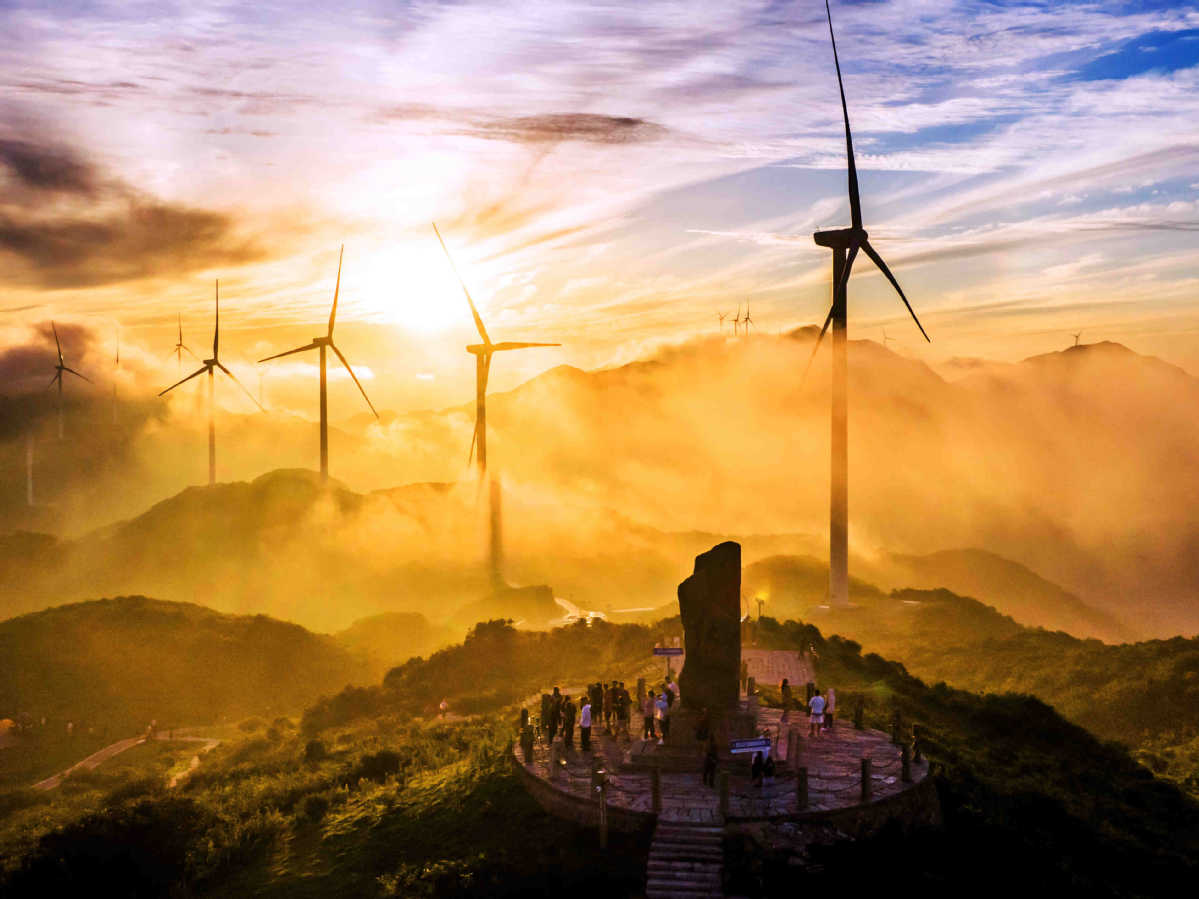
Under the leadership of the Communist Party of China, the nation is now taking the lead in renewable energies. Over the past decade, global solar panel manufacturing capacity has increasingly shifted from Europe, Japan and the United States to China, which has become a leader in investment and innovation in solar panels. The International Energy Agency said in a special report in July that China now holds a market share in excess of 80 percent in all the stages of solar panel manufacturing.
The latest UN projections suggest that the world's population could grow to around 8.5 billion in 2030 and 9.7 billion in 2050, before reaching a peak of around 10.4 billion people during the 2080s. The population is expected to remain at that level until 2100.
The planetary crises such as climate change are putting the living environment of humans and other species in jeopardy. We need the concept of ecological civilization to achieve a harmonious relationship with nature.
The 20th CPC National Congress is an opportunity for China to celebrate more than 40 years of the most unprecedented economic growth anywhere and at any time in world history and the success of bringing nearly 100 million rural residents out of poverty. It is also the opportunity to highlight the country's resolve to accelerate its green transition.
The author is president of the Belt and Road Initiative Green Development Institute and former executive director of the United Nations Environment Programme. The views do not necessarily reflect those of China Daily.




- China-Laos Railway handles over 60 million passenger trips
- Bangladesh's young boy recovering after undergoing specialized surgery in Hubei
- Shanghai pioneers music therapy committee to advance mental health care
- No casualties reported after 5.4-magnitude quake in China's Sichuan
- Village in Guangzhou announces subsidy for patients with mosquito-borne diseases
- Guangdong railways set passenger record during National Day holiday