



Witness of history
A four-month exhibition provides an opportunity to reassess the life and times of Ming Emperor Wanli, Wang Kaihao reports.









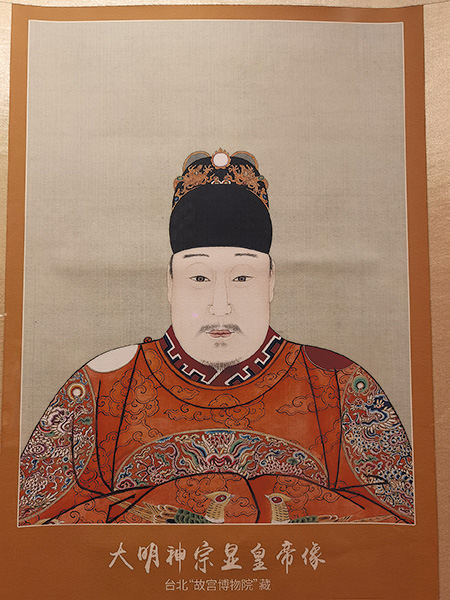
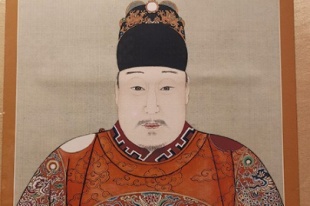
An exhibited replica of a Ming portrait of Emperor Wanli. The original piece is now in Taipei.
[Photo by Wang Kaihao/China Daily]
The emperor's crown, which was knotted with more than 500 gold threads, is among the highlights of the exhibition. Each thread is no wider than 0.2 millimeters, and the crown weighs about 800 grams. A pair of dragons are entrenched on both wings of the crown, and some 8,000 gold "dragon scales" are used to decorate the crown, showcasing advanced techniques back then.
"This is the only artifact of its kind ever found in China," Feng says. "In an era when artisans only had experiences as references, it was tremendously challenging to uncover the exact right timing to both weld and create such an impeccable shape."
In the 1950s, China had its first and so far the only archaeological excavation of the Ming imperial tombs. Wanli's mausoleum, also known as Dingling, was opened. More than 3,000 cultural relics were found in his tomb. For example, the exquisite royal robes worn by the emperor and his empress may urge people to admire the refined artistic taste. However, they are also testimony of an etiquette system, emphasized throughout Chinese history.
"The Ming Dynasty ruled the country through a stratified etiquette system that is rooted in Confucianism," Feng explains. "The system guided politics, social and economic development, diplomacy and many other aspects of national governance, as well as people's daily behavior."
Apparently, constructing the grand mausoleum was a crucial part of this etiquette system. Emperor Wanli chose the location of his future resting place when he was only 21. It took six years to construct Dingling, the layout of which is almost a replica of his splendid lifetime home, the Forbidden City.
"Ancient Chinese people tended to treat their afterlife just like their lifetime," Feng says. "The splendor of Wanli's mausoleum reflects his regular lifestyle. He wanted to enjoy life even after it would go."


















