


Up close and personal










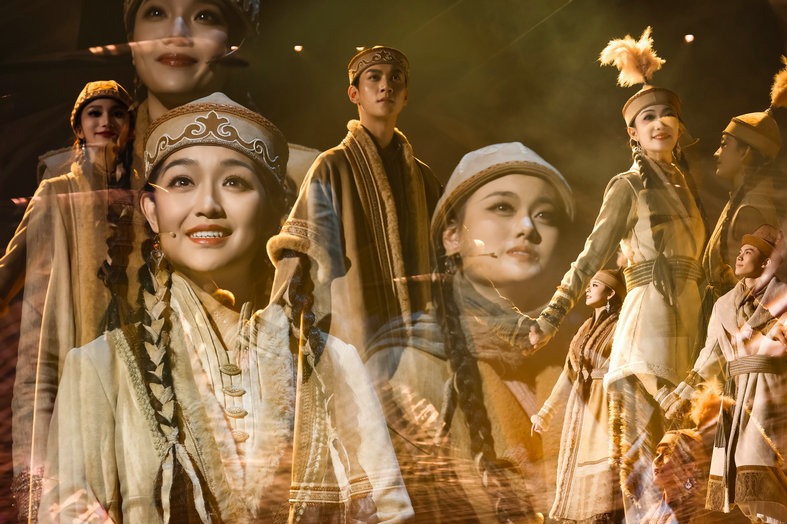
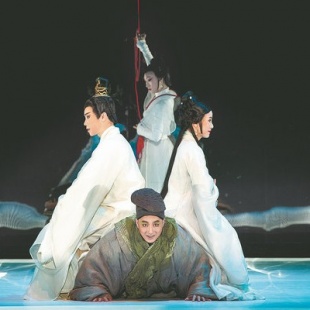
"In Chinese culture, the red bean symbolizes romance between lovers. The story of Red Bean displays the beautiful singing and acting of Xiju Opera," she adds, noting that one of the performers is Xiju Opera actor Wang Ziyu, whose grandfather, Wang Binbin (1921-2008), was known as one of the leading actors of Xiju Opera. His singing style, known as binbin qiang, has been inherited by his son, Wang Jianwei, and now his grandson, Wang Ziyu.
Besides Xiju Opera, Wang Ziyu also learned Kunqu Opera — one of the oldest existing forms of traditional Chinese operas, with a history of more than 600 years.
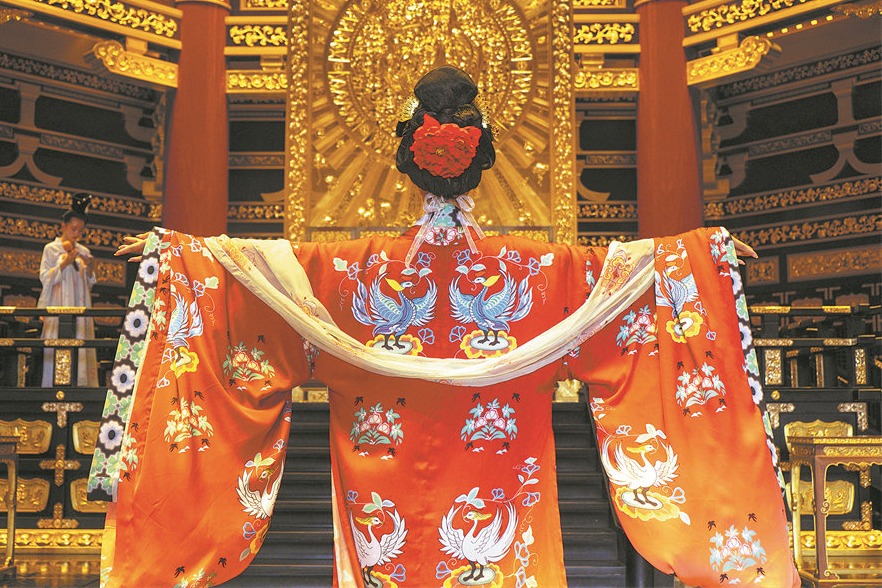
"Wang Ziyu plays the role of the prince and the emperor. He switched between the two totally different characters within seconds onstage, which presented great challenges. There are two performers onstage without any lines," says An, who talks about the experimental elements featured in the production. "Though it is a tragic love story, the stage set is beautifully decorated with mirrors, which is something rarely seen in Xiju Opera productions."
Over a decade ago, An worked with Chinese theater director Li Liuyi, playing in Li's small theater productions, such as a trilogy portraying three female heroes, Hua Mulan, Mu Guiying and Liang Hongyu.
As she recalls, the experience allowed her to get to know small theaters, where new works were made for innovative live art.
Red Bean is An's first production for such venues. "It has strong emotions. I wanted to disrupt the relationship between audience and performer," says An, adding that, for actors and actresses, it is challenging to perform at such venues because all the performers' movements can be seen clearly by the audience.
According to a 2015 survey, there were 348 forms of traditional Chinese opera, a decline of about 60 from 1999.
"During the past 10 years, small theaters have made a great contribution to attracting a younger audience. It's true that traditional art forms are fighting to survive. We are glad to have such venues to help pave the way for old art forms to find new life," she says.