Understanding the core
As the oldest form of Chinese drama, Kunqu Opera originated in Jiangsu province during the Ming Dynasty (1368-1644). It has southern Chinese characteristics and spans multiple periods, incorporating a wide range of content, including poetry and songs.
"Some of its lyrics can be quite obscure and challenging to understand, with hidden meanings that even Kunqu performers may need to consult old Chinese dictionaries to decipher. For foreigners, it's even harder," Cheng says.
He says that the Society provides subtitles in both Chinese and English on a screen by the side of the stage to help the audience understand more effectively.
"We have observed the changing demographics of our audience. In earlier years, there were more attendees with black hair and gray. Over time, there were more blonde heads, and now we even see attendees with brightly colored hair," he says, implying that the audience is transitioning from older Chinese to younger, and non-Chinese today.
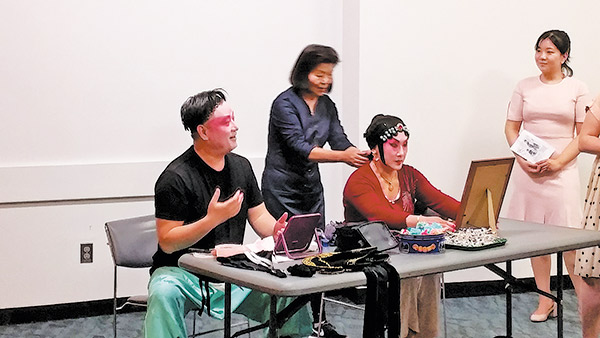
Many Chinese adults become eager to learn Kunqu after watching operas like The Peony Pavilion, The Peach Blossom Fan, or The Palace of Eternal Life, or after falling in love with a particular character like Du Liniang (the heroine in The Peony Pavilion). However, learning to perform a specific character type in Kunqu, whether it's dan (female), sheng (male), jing (painted face), mo (middle-aged man), or chou (clown), is a matter of destiny, says Shi Jiehua, the resident Kunqu instructor.
Shi says that many girls are interested in playing the role of Du Liniang, but their appearance and voice may not be suited to the character's requirements.
"Once students learn the basics of Kunqu and realize they may not be suitable for the character they initially chose, and if they still have a genuine interest, they explore other options," she says. "This is how we get students who are genuinely committed rather than those who just have a fleeting interest."
Xu from ShanghaiTech University says that there is a growing need for colleges to develop "internationally infused theater curricula".
"Kunqu, with its deep classical roots and modern appeal, has the great potential to fill the gap," Xu says, adding that more radical and creative kinds of technologies have been applied in many Kunqu Opera performances, such as virtual and mixed reality, that may take the art form in new directions.
We are seeking collaborators in science and technology to create new ways to bring traditional stories and classical tunes to life through new mediums, Xu says.