


Depths of understanding









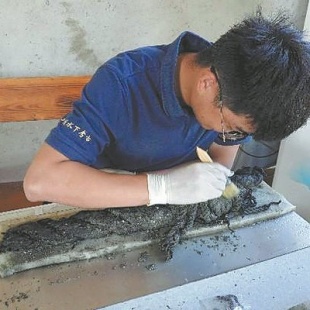
Archaeologists have made some innovative attempts to preserve the artifacts as they were being removed from the water. For example, they sprayed epoxy resin around the cultural relics underwater, which then formed a protective shell. After getting them out of water, they dismantled the shell and checked the artifacts.
"They were soaked in water for about 700 years and were very vulnerable. We adopted the new technique to ensure their integrity," says Chen.
Archaeological studies on the Shuomen ancient port site in Wenzhou, Zhejiang, have revealed the port was a major distribution center for transporting Longquan celadon to overseas destinations during the Song and Yuan dynasties. Combining the two discoveries, archaeologists infer that the Shengbeiyu shipwreck was a private commercial ship transporting goods from the Wenzhou port to Southeast Asia.
"The archaeological efforts expended on Shuomen port and the Shengbeiyu shipwreck complement each other. They reveal details of a port and a ship respectively, displaying the history of the Maritime Silk Road, both of which are meaningful for our studies on the history of China's maritime civilization," says Jiang Bo, a professor at Shandong University's School of History and Culture.
The archaeological work finished in October, and the site has been backfilled for protection.
According to Wang Guangyao, a researcher at the Palace Museum in Beijing, during the archaeological work on the Shengbeiyu shipwreck, archaeologists made breakthroughs in their methods and techniques, representing a major progress in the country's underwater archaeology.
China has attached great importance to the development of underwater archaeology.
The National Cultural Heritage Administration has recently issued regulations on underwater archaeological work.
"The regulations highlight the technical specifications of underwater archaeological work, specify the key points of underwater archaeological techniques, and unify standards for data collection, archaeological records, and other aspects. They put forward higher requirements for underwater archaeological research and bring cultural relics back to life," says a statement released by the administration.