


Towering determination of pagoda chronicler
Telling the stories of ancient structures is a passionate undertaking for enthusiast, Yang Yang reports.









Telling the stories of ancient structures is a passionate undertaking for enthusiast, Yang Yang reports.
More than a decade ago, ancient pagoda enthusiast Wu Kai was looking for a book that systematically and comprehensively detailed the total number and locations of the pagodas, and provided introductions with good-quality photos.
"I read a lot of books. But I found that the pagodas they included are limited, with many mistakes and lacking clear logic. I decided to create such a book myself rather than wait for someone to complete the task," he says, adding that, "after all, over the years I have systematically collected and organized plenty of materials".
Wu fell in love with ancient pagodas when he was a student studying physics at Tsinghua University. "I didn't know much about them at first. I just found them appealing to look at," he recalls.
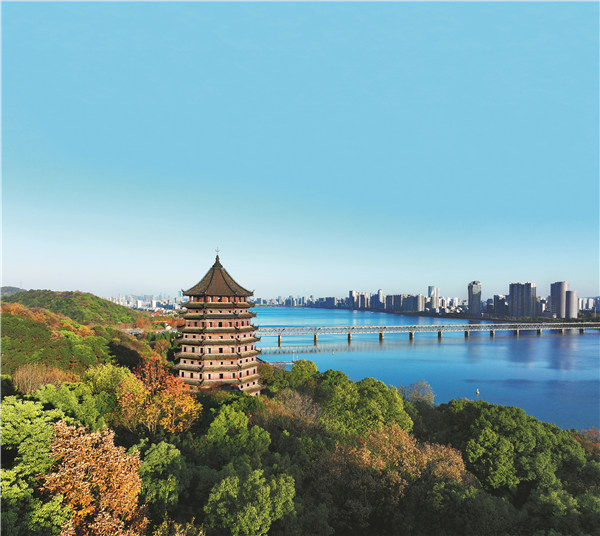
"Ancient Chinese people tended to build large-scale structures, but not tall buildings, and the pagoda was the only tall building they erected that lasts to this day," Wu says. "They are so conspicuous that they became landmark buildings.
"I love them, possibly because they are among the best carriers of Chinese culture."
Originating in India, stupas, dome-shaped structures, were built to enshrine the relics of the founder of Buddhism, Sakyamuni. Nearly 2,000 years ago, stupas were introduced to China along with Buddhism. At that time, Chinese people had already started building multitiered wooden square watchtowers.
Creatively combining the stupa form factor and the watchtower design, Chinese architects created something new — multistoried pagodas, which had the metal spire of a stupa, but the body of a multitiered Chinese wooden square tower.
A portrait brick from the Eastern Han Dynasty (25-220) unearthed in Shifang city of Sichuan province in 1973 reveals the earliest image of a Chinese pavilion-style pagoda — a three-story building.
In the following 2,000 years, pagodas have evolved into many more styles, including dense-eave, Tibetan-style inverted bowl, Vajrasana and Dai-ethnic-style pagodas. The shape of a pagoda body has also developed from square to hexagonal, octagonal or round.