



Paranoia bad for EU's economic security









It felt weird to hear an argument again in a seminar at the European Policy Center in Brussels on Wednesday that the European Union should become self-reliant and not depend on China for face masks.
But the panelist who said this did not present any evidence that China has in any way blocked exports of face masks to the EU, or any other economy for that matter. On the contrary, Chinese Ministry of Commerce data show that in 2020 alone, China exported more than 220 billion face masks, 2.33 billion pieces of protective gear and 1 billion test kits.
Despite Washington's reckless and hostile China-containment policy, China exported some 44 billion face masks and billions of surgical gloves, and protective gear and goggles to the United States in the 12 months starting March 1, 2020.
The truth is that China has a comparative advantage in making such products, In contrast, the EU's much higher labor cost makes manufacturing such products financially unviable.
Economic security and "de-risking" are hot subjects in the EU these days. But much of manufactured fear arose from overreaction or even paranoia due to the prolonged COVID-19 pandemic, the continuing Russia-Ukraine conflict and US-China geopolitical tensions.
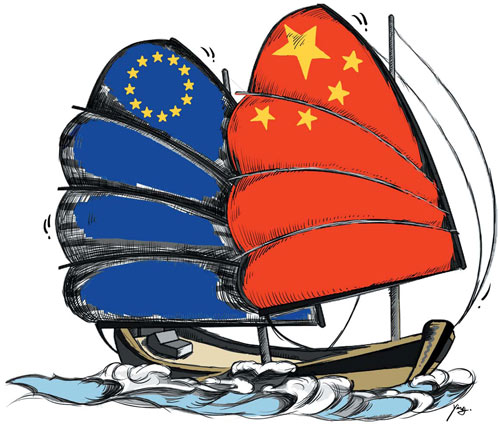
However, it is foolish to assume that China would sour the investment and trade relations with the EU given their economic interdependence. Rocking the boat will be suicidal for China as much as for the EU, especially for China's key trade partners such as Germany, France and the Netherlands.
One EU pundit agreed with me that increasing such interdependence is good for maintaining a stable relationship. If you were to wrongly believe that China and the EU would fight a Cold War or a hot war, you should prepare for the worst-case scenario. But who with a sound mind would even contemplate such a scenario. It would be insane.
China has been a beneficiary of economic globalization, and is the top trading partner of more than 120 economies. Peace, stability, free trade, an open global economy and freedom of navigation mean a lot to China. That's also why China has joined the Regional Comprehensive Economic Partnership and has applied to join the Comprehensive and Progressive Agreement for Trans-Pacific Partnership.
China has never used trade as a weapon against the EU. Lithuania's case, unlike what some in the EU argued, is not about the EU as a whole but rather one EU member state which crossed the redline of violating the one-China principle which it has promised to observe.
China could make a much stronger argument by stressing that it was under US pressure that the EU banned China's Huawei from its 5G network and the Netherlands' compromised its sovereignty by forcing its chipmaking equipment giant ASML to restrict exports to China.
On the false pretext of economic security, the EU has revved up its industrial policy and taken many protectionist measures in recent years, including the huge state subsidies the European Commission approved this week for two German and French battery and clean technology companies.
Ironically, the EU has just launched an anti-subsidy investigation against Chinese electric vehicles, which have gained a substantial share of the global market due to China's early start and huge investments for years instead of granting subsidies to EV manufacturing companies.
When I asked one European industry analyst who complained about the EU's increasing public intervention in the supply chains, he said he was referring to those subsidies "will not" help make the EU competitive.
China and the EU have developed a strong and mutually beneficial economic and trade relationship over the past more than four decades despite their many differences. For example, China's solar panels and EVs could play a big role in the EU's "Green Deal" and help EU achieve carbon neutrality faster and at a lower cost.
Irrational de-risking based on paranoia will leave both the EU and China worse off, and undermine the global cooperation to overcome global challenges such as climate change and any future pandemics.
The author is chief of China Daily EU Bureau based in Brussels. chenweihua@chinadaily.com.cn


