



Western democracy sees increasing erosion of trust









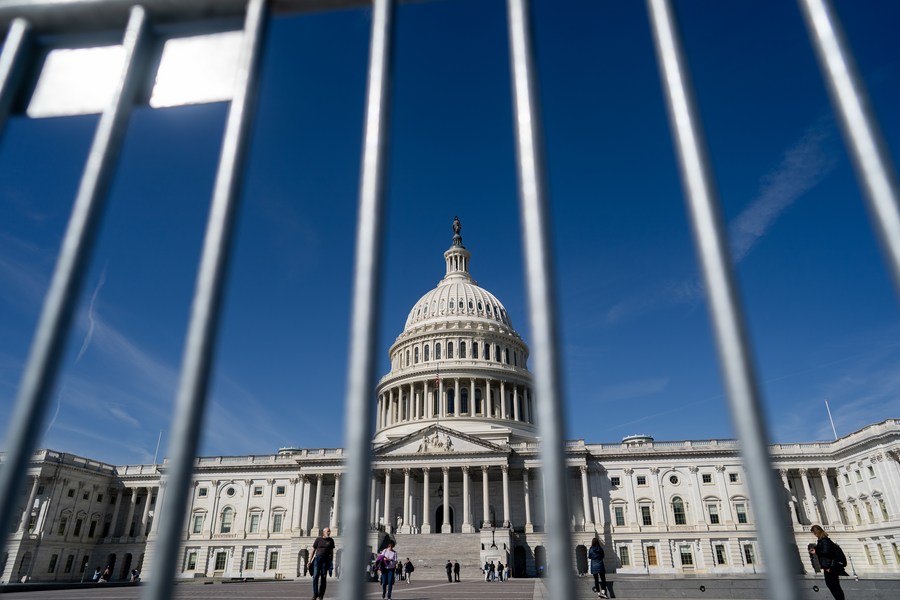
Western nations are always ready to proclaim their system of governance as superior, particularly in regard to China, which they dismiss as being "authoritarian". Increasingly, however, Western liberal democracy finds itself under scrutiny, with trust in government falling.
Growing numbers feel alienated, believing that the democratic system has been taken over by elites with little or no interest in their plight, with government viewed more and more to be under the sway of big media, business, lobbyists and moneyed interests.
Political parties, understood to have been captured by such interests, attract diminishing members, further enabling concentrated control by the few. Parliaments increasingly are seen as places of theater, where often nothing substantive is discussed, never mind achieved, while political action through protest movements is falling on deaf ears. At the edges, growing numbers believe a range of conspiracy theories.
Disillusioned and alienated, many have turned to a right-wing populism that promises simplistic solutions to the ordinary voter as an alternative to a "failed" political establishment. Such parties have gained, or threaten to gain, power in Italy, France, Germany, the Netherlands, Argentina, Brazil and the United States.
There is good reason for disillusionment. The wealth gap between the rich and the poor continues to grow in some of these countries. Ordinary people have experienced a depreciation in their economic status, housing has become less affordable and employment less secure, while the prices of staples such as food have escalated, with wages stagnating.
Researcher Simon Bienstman, citing numerous studies, has detailed the connection between social inequality and the erosion of trust in government.
After surveying trust in public institutions across member countries, the Organization for Economic Cooperation and Development concluded that "public confidence is now evenly split between people who say they trust their national government and those who do not. Historical data show that it takes a long time to rebuild trust when it is diminished. … Many people in OECD countries see equal access to policymaking processes as falling short of their expectations."
The OECD found in 2022 that average trust in government was 41.4 percent, with 41.1 percent not having trust. For Australia, the respective figures were 38 percent and 43.8 percent.
Trust levels fell further among disadvantaged groups, younger people, women, those feeling financially insecure and people with low levels of income and education.
Political polarization is related to trust, with those not voting for the incumbent government much less likely to trust it.
In Australia, the slide in trust has been precipitous. As recently as 2014, 72 percent had trust in government. Now, less than 41 percent of Australians surveyed said they were satisfied with the way democracy works in Australia, down from 86 percent in 2007.
We have entered what the Pew Research Center called in 2017 a global "democratic recession".
Loss of trust has been the strongest in the US, the leading Western democracy.
The US is marked by massive polarization. Thus, during the presidency of Donald Trump, 36 percent of Republicans surveyed said they trusted government, while only 12 percent of Democrats did. With the election of Joe Biden to the presidency, the figures reversed.
Veteran Singaporean diplomat Kishore Mahbubani has said that democracy needs be guided by two principles. The first principle emphasizes that each person should have "an equal right to the most extensive liberty", while the second says that social and economic inequalities are to be arranged so that they are to "everyone's advantage", he said.
Under the neo-liberalism of small government, the second of these principles has been absent.
This rising inequality and financial hardship have led to a sea of despair, in which lies great risk.
What makes this worse for the US, with its loss of assumed hegemonic dominance, is that it faces a highly virile counterpart in China, whose level of trust in its government stands at around 90 percent.
The author is a Newcastle-based historian, theologian, social commentator and published author of three books. His blog may be found at www.johnqueripelblog.com. This article was published by PEARLS & IRRITATIONS website at: https://johnmenadue.com/western-democracy-failure-of-system/. The views do not necessarily reflect those of China Daily.








