



ABB eyes AI-robotics integration to push growth in various businesses









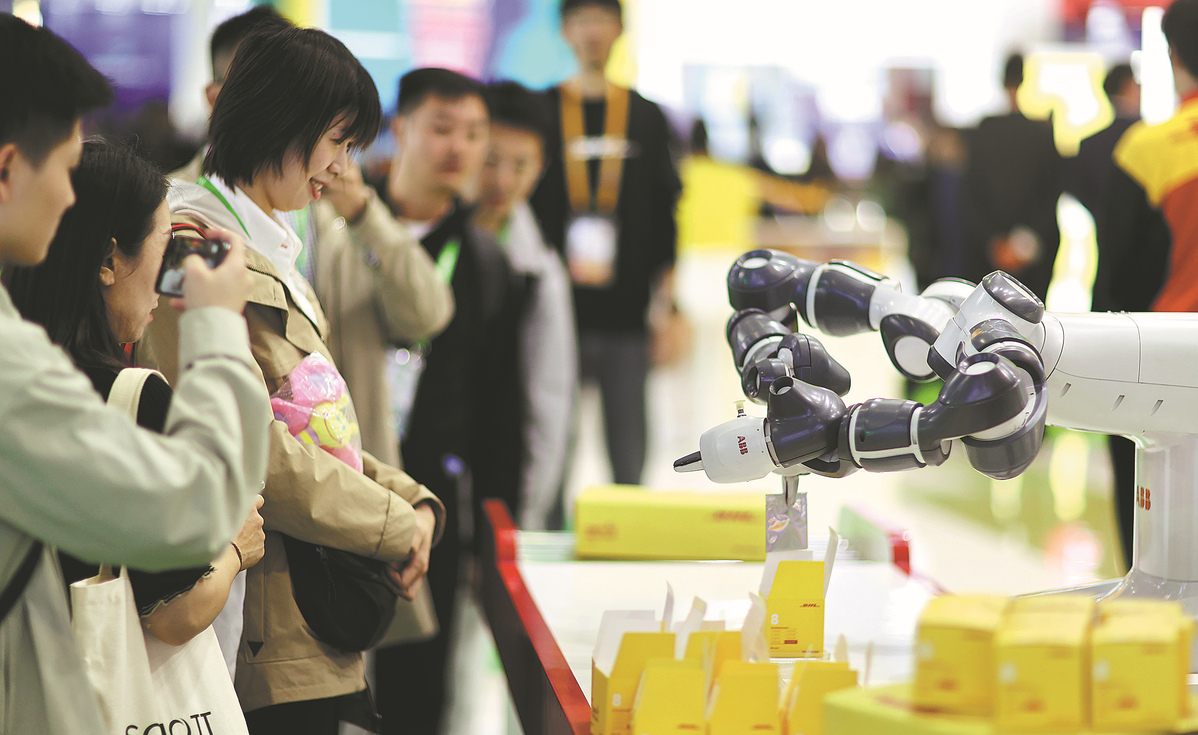
ABB Ltd will integrate artificial intelligence with robotics across various sectors in China to sustain robust growth, senior executives of the Swiss-Swedish technology and engineering group said, as AI continues to evolve at an unprecedented pace, transforming numerous industries.
China is not only the world's largest robotics market but also a leading player in the global AI landscape, said Han Chen, president of ABB Robotics in China.
ABB plans to leverage this integration of AI with robotics in sectors such as automotives, consumer goods, education and emerging areas like healthcare, retail and new energy.
"This strategic move aims to create additional value for customers by introducing new levels of autonomy in robotic applications across China," Han said.
Small and medium-sized enterprises will gain cost-efficient access to robotics due to lowered entry barriers and simplicity of use through AI, he added.
As an early adopter of a national AI strategy, China has implemented various comprehensive action plans and incentive programs, focusing on an "AI plus "approach.
The rapid development of AI in China has been fueled by a combination of factors, including robust market demand with diverse application scenarios, solid policy support, and advanced computing infrastructure, said the Ministry of Industry and Information Technology.
According to a report by market research firm CCID Consulting, China's AI industry is expected to make great strides in the next 10 to 15 years, with market scale reaching $240.4 billion by 2035, accounting for 30.6 percent of the world's total.
Sami Atiya, president of ABB's robotics and discrete automation business, said the group has already embedded AI into its business, with over 100 AI projects in process, of which several are located in China.
"As the development of generative AI continues at pace, we are experiencing a significant leap forward in how we work, learn and innovate," said Atiya, who also is a group executive committee member at ABB.
Machines are getting smarter, more capable and easier to use, lowering the barriers to automation for all companies. This advancement addresses the needs of its customers for enhanced flexibility and intelligence, especially in the face of critical skilled labor shortages and global uncertainties, he added.
To meet the growing requirement for AI-powered robotic solutions, ABB has invested in its facilities and AI innovation capability in recent years, including the inauguration of a world-class robotics megafactory in Shanghai with a new research and development center on innovation of AI, digitalization and software, the expansion of its existing robotics factory in the United States and in Sweden to increase production capacity and develop next-generation AI-enabled technologies.
In January, ABB acquired Swiss startup Sevensense Robotics to enhance its competitiveness in next-generation AI-enabled autonomous mobile robots and also a majority stake in Bosnian software services provider Meshmind to further advance AI and software-driven automation.
AI has been quickly integrated into various sectors. Earlier this month, US-based AI research company OpenAI unveiled a new product named Sora, which is capable of generating "realistic" and "imaginative" 60-second videos based on brief text prompts.
As industrial-grade, large-scale AI models gradually emerge, AI will become increasingly embedded in various stages of industrial production. General AI is being applied in design, intelligent manufacturing, quality management and autonomous driving, said Chen Zhi, director of the Institute of Innovation and Development, which is part of the Beijing-based Chinese Academy of Science and Technology for Development.
For instance, the integration of AI with electronic design automation is becoming a mainstream trend in chip design. AI large models enhance industrial robots' understanding of natural language commands, improving their information processing and perceptual execution capabilities, said Chen.








