



Summit shows Australia looks to profit from engagement with ASEAN









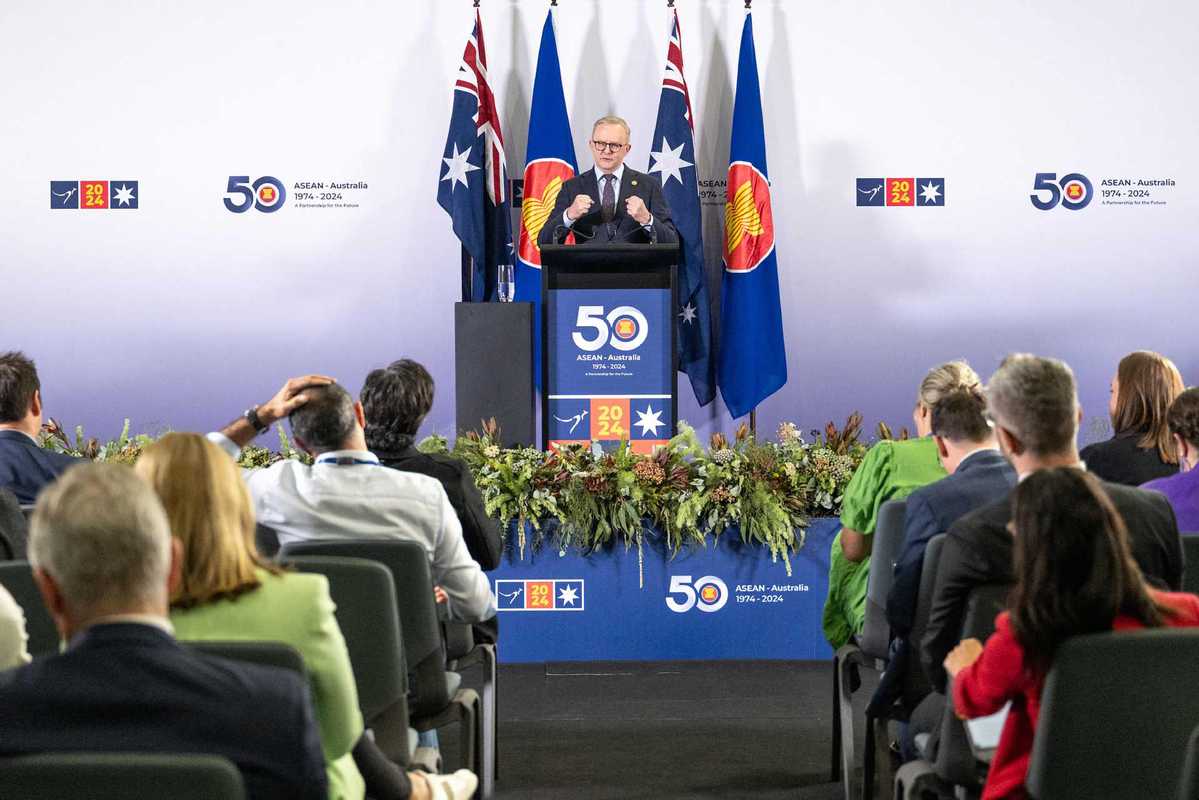
Addressing the leaders of the 10 member states of the Association of Southeast Asian Nations at a recent three-day summit in Melbourne, Australian Prime Minister Anthony Albanese said he was pursuing "the most significant upgrade of Australia's economic engagement with ASEAN for a generation".
There were some passing words about cooperation, but there was no mistaking that in the eyes of Canberra, ASEAN represents a wonderful opportunity for Australian business.
His comments left no room for doubt that Australia believes it has so much to offer ASEAN in terms of green energy. This is a repeated refrain often heard in Australia, but it may have come as a surprise to the ASEAN participants who have been more closely involved with the truly dramatic advances in green and clean initiatives coming out of China.
Australia is struggling with its green energy transition at a time when China is deploying more solar panels in its grid annually than are installed in total by the rest of the world.
The address by Australian Foreign Minister Penny Wong also stumbled around the concept of ASEAN centrality and the role played by the global rules-based order. Her speech was all about the importance of the rules-based order. Later she stressed "the importance of ensuring that international law continues to operate and be respected and observed, particularly in the South China Sea and the region".
However, Malaysia and Indonesia, and other countries with significant Muslim populations, might reflect on Australia's silence on the allegations of war crimes in Gaza, and Wong's rapid suspension, without evidence, of funding to the United Nations Relief and Works Agency for Palestine Refugees in the Near East.
"We face destabilizing, provocative and coercive actions including unsafe conduct at sea and in the air," Wong said in a speech during the Maritime Cooperation Forum of the ASEAN-Australia Special Summit in Melbourne, without naming China, although it was clear that is where her finger was pointing. She also did not acknowledge that it is Australia and the United States that persist in conducting provocative near-to-shore freedom of navigation exercises that they themselves would not tolerate if undertaken by China close to their shores.
Her comments also begged the question of who are the "we" she talked about. Southeast Asia has peacefully coexisted for centuries with China, long before Australia and the US existed. The long arc of history shows that ASEAN was influenced socially and culturally by China. It is a foolish rejection of history to suggest this is somehow a new phenomenon and therefore a so-called threat that needs to be countered by ASEAN.
Malaysian Prime Minister Anwar Ibrahim made it very clear that if Australia and the US "have problems with China, they should not impose it upon us. We do not have a problem with China".
Both Albanese and Wong referenced a report titled "Invested: Australia's Southeast Asia Economic Strategy to 2040", written by Nicholas Moore, Australia's special envoy for Southeast Asia. The report supported increased engagement in ASEAN because, in large part, there was money to be made from the growing middle class.
The report made scant mention of the Belt and Road Initiative and the role it is playing in ASEAN's cooperative development, which is perhaps why Australia launched the Southeast Asia Investment Financing Facility, as if it were a major contribution to the region. The fund is designed to assist Australian businesses to tap into growing demand for renewable power in the region between now and 2050, so it is more about profit than cooperation.
The comments from Australian leaders fell short on the ASEAN concept of cooperation and assistance, but were strong in pushing for ASEAN to follow a Western agenda in the region and making room for Australian businesses to profit from the region.
The concept of ASEAN centrality was paid lip service in an attempt to disguise the carpetbagging approach to regional engagement in which Australia's interests come first.
The author is an international financial technical analyst and a former national board member of the Australia China Business Council.








