


Fantastical flying beasts
Major Beijing exhibition traces history of the dragon through 8,000 years of imagery, Wang Ru reports.










Moreover, says Guo, dragon totem artifacts are a reflection of the characteristics of Chinese civilization.
"Since (the dragon) has a long history, it shows the continuity of Chinese civilization. The changes to its image show creativity. It also shows peacefulness, as the dragon was originally believed to be connected with celestial phenomena associated with agriculture, and was often thought to control rainfall, which was vital to agricultural society.
"As a result, people worshipped the dragon to pray for good weather for their crops. It's totally different from the Western concept of the dragon."
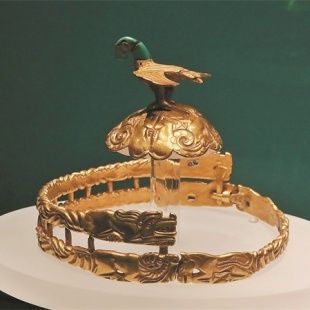
Dragon artifacts also demonstrate the inclusiveness of Chinese civilization. For example, a gold necklace from the Western Jin Dynasty (265-316) unearthed in Inner Mongolia blends different cultural features. The necklace has dragon heads on both ends, and is decorated with small models of traditional Chinese weapons like shields, ji, or polearms, and yue, a kind of axe.
Guo says it has obvious Scythian (nomadic tribes that flourished between the 7th century BC and 4th century AD), Gandharan and Indian elements, and that the dragon and the weapon decorations are typically Chinese. As a result, the necklace is evidence of cultural communication.
Many of the exhibits are extremely precious and it was not easy to assemble them.
Some are newly unearthed and are being exhibited for the first time. For example, the dragon pieced together from clam shells dating to about 6,300 years ago, was found at the Caitaopo Site in Chifeng, Inner Mongolia last year.
"This is a dragon artifact that dates back to the early period of Hongshan Culture. Unlike the jade pig-dragon of the late Hongshan Culture period, which has a curled body, this one seems to be elongated, filling in a gap in early Hongshan dragon imagery," says Guo.
Another from the Lingjiatan Site, which was unearthed in 2022, takes a special form. The artifact is tubelike, with one end carved like a dragon head lifting its head, and the other end a pointed cone shape.
"This is the only example of this form of dragon found so far, and we haven't been able to determine what it was used for," says Guo.
With a chronological sequence spanning 8,000 years of dragon culture, and its collection of the most representative artifacts, Ma says the exhibition is expected to play a crucial role in promoting and disseminating dragon culture during the Year of the Dragon.
"I had never seen so many artifacts with dragon elements brought together in the past," says Wang Mingda, a veteran archaeologist who worked at Liangzhu for decades. "I have seen and even handled some of the exhibits as part of my work, but I have never seen them all together before."