


Brushing up a legacy









Editor's note: Traditional arts and crafts are supreme samples of Chinese cultural heritage. China Daily is running this series to show how master artisans are using dedication and innovation to inject new life into heritage. In this installment, we find out why the Four Treasures of the Study are not merely tools used by literati but also carriers of Chinese heritage.
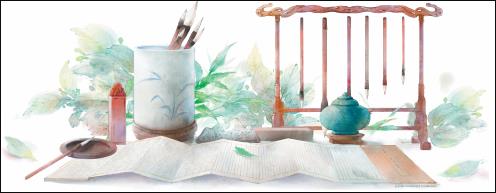
A short soft brush connected to a long hard handle, both vigorous and gentle — a simple Chinese writing brush can describe the most sophisticated idea. Achieving both technical excellence and spiritual freedom in writing, a good brush allows for unrestrained creativity and endless variation.
A brush can reveal a dot, a line, the sun, the moon, mountains, rivers, wind and everything people can sense in the world, slender or thick, big or small, concrete or abstract.
Perhaps it is one of the few tools invented by humans that is so practical yet so rich in symbolic meanings over millennia. It not only conveyed common people's care and emotions, but also recorded history, narrated thoughts, and created the most refined art and literature of this culture, thus greatly influencing the development path of Chinese civilization.
In his book Huzhou Writing Brush and Chinese Culture published by Peking University Press in 2010, scholar Ma Qingyun quotes Zhou Ruchang (1918-2012), a prestigious scholar, poet and calligrapher, as saying that: "Without the writing brush, Chinese characters could not have undergone their evolution, not to mention the painting art. Their forms, structures, writing methods, functions and artistic effects would not have arrived at the current situation. Ultimately, the writing brush determines the various forms of documents, such as scrolls, books, records, letters and files."
Ma says: "For Zhou, the spiritual essence of Chinese culture is manifested in the writing brush, and its development depends on the writing brush as well."
For him, the diverse temperaments, personalities, wills, spiritual worlds, attitudes toward life, external grace, internal beauty, and cultivation of the Chinese people all flow from the tip of that brush, Ma says.
"So, the writing brush is not only a representative of Chinese culture, but also the creator of Chinese culture," he adds.