Increased exchanges spur more Zambians to learn Chinese









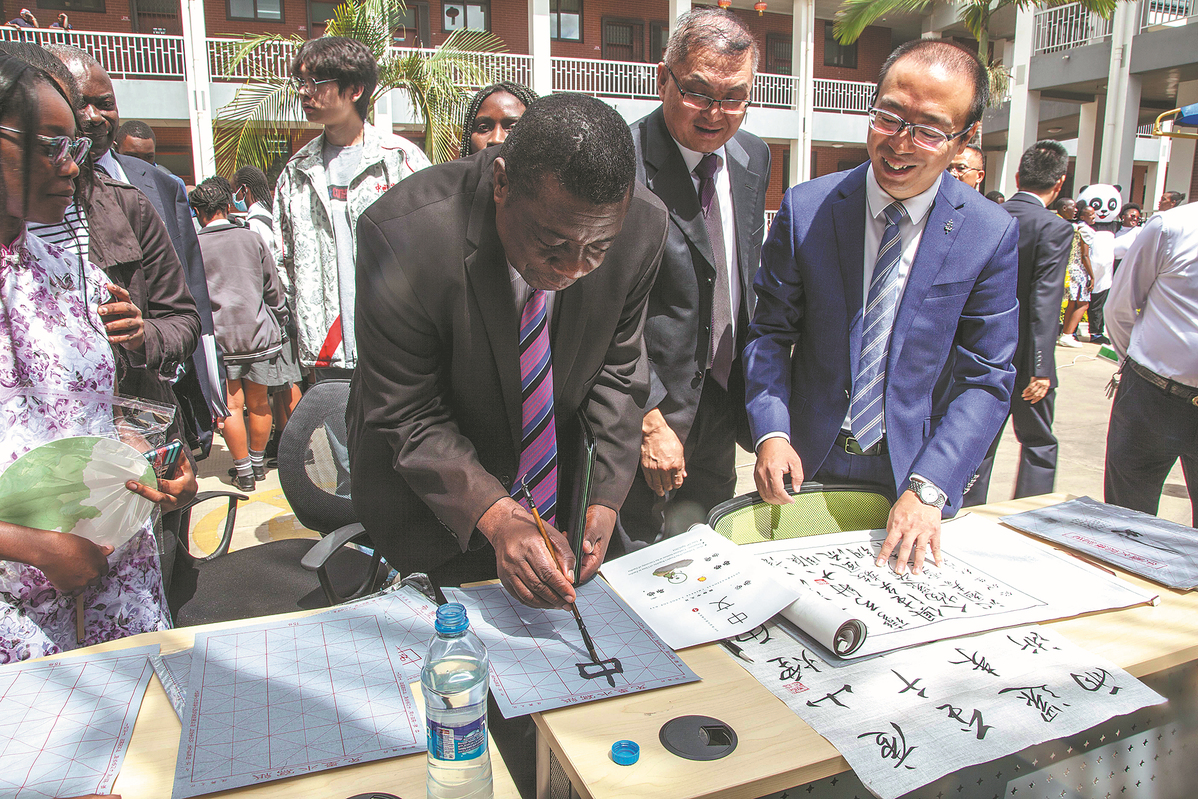
Spurred by intensified economic and cultural exchanges, as well as communication between China and Zambia, more institutes in the Southern African country are offering Chinese courses to meet the increasing demand for the language.
In Livingstone, a tourism city famous for Victoria Falls, Livingstone Institute of Business and Engineering Studies, or LIBES, is spearheading an initiative to teach Mandarin to professionals in Zambia.
Ignatius Lubinda, the principal of LIBES, has outlined the strategic vision behind this educational shift, emphasizing its importance for communication and economic enhancement.
"We are integrating Mandarin into our curriculum just as we teach communication skills in English," Lubinda said.
"Our goal is to improve the way our learners communicate with Chinese counterparts," he said, adding that the initiative aims to enhance communication and foster better business and diplomatic relationships.
Lubinda said a major reason for the institute to promote Chinese learning is to meet the increasing demand for Chinese speakers from the hospitality industry as the city receives a lot of tourists from China every year.
"We are training tour guides, receptionists, waitresses and other professionals who interact with tourists," Lubinda said.
By equipping these workers with Mandarin skills, LIBES aims to enhance the visitor experience for Chinese tourists, a growing demographic in Zambia's tourism sector.
"We are planning to target the possibility of having an executive class in the evening so that the working class can join," Lubinda said, adding that the move is aimed at ensuring professionals who have regular daytime jobs can still benefit from Mandarin education.
"A number of students have been trained and are now applying their skills in various sectors," Lubinda said, adding that breaking language barriers can benefit Zambia in tourism, investment and business opportunities.
Key institutions
In addition to LIBES, the Confucius Institute at the University of Zambia is also spearheading the initiative to teach Mandarin across the country, offering Chinese language programs at 19 teaching centers. Other key institutions that plan to offer Chinese language courses include Mulungushi University and Copperbelt University.
By incorporating Mandarin into the curriculum, Zambia is fostering better international relationships and positioning itself strategically in a world where the centers of power are shifting.
Malizgani Nyirongo, a distinguished language expert and historian in Zambia, emphasizes the benefits of this move.
"The Chinese have been living in Zambia and southern Africa for a long time, as evidenced by archaeological finds," said Nyirongo.
This deep-rooted historical presence forms a foundation for the robust relationship between Zambia and China today.
"Learning the Chinese language is significant because of the impact it has on trade and commerce," he said. "China is a global player. You have to deal with China in trade, commerce, education, medicine and technology."
By understanding Mandarin, Zambians can navigate Chinese manuals, tap into advanced technologies and appreciate Chinese innovations in science and medicine, he said.
Beyond economic benefits, learning Mandarin fosters deeper cultural understanding and promotes people-to-people exchanges.
"Learning the Chinese language will bring us closer to China," Nyirongo emphasized, adding that direct engagement counters often skewed narratives presented by Western media.
Nyirongo envisions a future where Mandarin is examinable in more Zambian schools, preparing students for studies in China.
This early preparation aligns with Zambia's broader educational goals, ensuring its youth are globally competitive and culturally adept, he said.
Emmanuel Mulenga, a resident in Lusaka, who learned Chinese in China, said mastering Chinese is challenging but rewarding.
"Learning Chinese has significantly helped me, especially in business contexts. Knowing Chinese gives you an upper hand in negotiations and opens up new opportunities," Mulenga, a translator for a Chinese company in Lusaka, said.
The writer is a freelance journalist for China Daily.