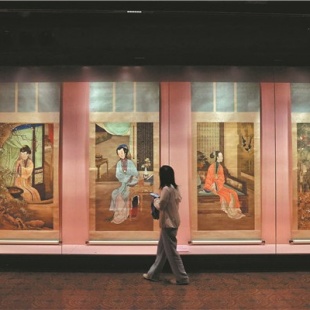



Picturing past perfection










The history
In the past, paintings depicting female figures, broadly referred to as shi'nyu tu or "court lady paintings", were a classic genre, with a long history and influence on traditional Chinese art. According to Xing Lunan, an associate researcher at the Palace Museum's department of paintings and calligraphy, and curator of the exhibition, the genre evolved, capturing the characteristics of each era.
"These paintings not only created idealized images of women, but also reflected the changes to their social status and living conditions over time, influenced by shifts in politics, customs, and trends," Xing says.
For example, during the Six Dynasties period — which refers to a period from the 3rd to 6th centuries when the southern part of China was ruled by six dynasties — delicate, refined images were preferred, echoing the then noble taste for inner peace.
Gu Kaizhi, an Eastern Jin Dynasty (317-420) master of painting, was responsible for the milestone Admonitions of the Instructress to Court Ladies, which celebrates honorable women in history and reveals a concern for the politics of his time. Though the original may be too fragile to survive to date, the monochrome Song Dynasty (960-1279) copy on exhibit still allows people to sense the ethos of Gu's era, through his smooth brushwork as well as his delicate and continuous lines.
Meanwhile, the graceful, voluptuous depictions of woman during the Tang Dynasty (618-907) may reflect the social prosperity of the time.
Huishan Shi'nyu Tu (On Court Ladies Waving Fans), which is credited to Tang painter Zhou Fang, is a perfect example.
Through depictions of the activities of 13 courtly women, the scroll adeptly portrays their identities and emotions. The figures are elegantly adorned, with plump, round faces. Born into a prominent family, Zhou was well-acquainted with the extravagant lifestyle of the aristocracy, and his paintings of court ladies often drew inspiration from the leisurely pursuits of noblewomen in real life.
The dignified elegance of the Song and Yuan (1271-1368) paintings, and the delicate and gentle Ming (1368-1644) and Qing (1644-1911) paintings, are both characterized by notable features.
"Early paintings centered around women often served an admonitory function to set moral standards," Xing explains. "After the Tang, the genre of painting beauties became a refined form that depicted the graceful demeanor of women that are pleasing to the eyes."