



People's congresses will continue serving people like in past 70 years









In September 1949, shortly before the official announcement of the establishment of the People's Republic of China, the special session of the Chinese People's Political Consultative Conference solemnly declared that New China will implement a system of people's congresses.
In 1954, the first session of the National People's Congress passed the Constitution, marking the establishment of a system of people's congresses as the fundamental political system of the country. This system is a form of democracy with Chinese characteristics. The past 70 years have proven that the system suits China's conditions and reality, reflects the nature of a socialist country, and ensures that the people are masters of the country.
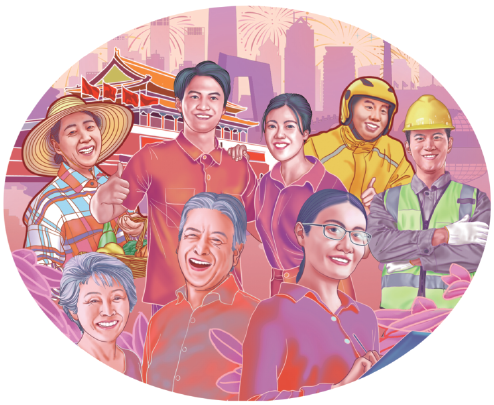
According to statistics, there are currently over 2.77 million deputies of the people's congresses, at various levels, representing a broad cross-section of society. The deputies give a voice to major public concerns and introduce legislative practices and policies that can benefit every household.
Democratic rights are not just exercised through elections. In 2023, the NPC website solicited opinions on 17 draft laws, receiving about 180,000 suggestions from various quarters; currently, the Legislative Affairs Commission of the Standing Committee of the NPC has established 45 grassroots legislative contact points, 7,300 provincial and municipal-level legislative contact points, promoting full-process people's democracy; and more than 200,000 deputy contact stations at the grassroots level actively play their roles under the leadership of the Communist Party of China, enabling deputies to widely connect with the masses.
A few years after the founding of New China, the NPC adopted the Constitution and several important laws such as those on organizing the Supreme People's Court. With the reform and opening-up, the NPC passed more essential laws including the Criminal Law and Criminal Procedure Law and by 2010 a legal system consisting of laws, administrative regulations and local regulations had been formed as scheduled. As of now, China has over 300 laws and approximately 600 administrative regulations along with over 14,000 local regulations.
Particularly noteworthy is the Civil Code passed in 2020, which serves as a basic law for the market economy in the country.
Looking back at the past 70 years, the system of people's congresses has adapted to the trends of the times and responded to public calls, providing crucial institutional guarantees for rapid economic development and long-term social stability. This system will continue to play an important role as the nation's fundamental political system.
- BEIJING NEWS


