Legacy of 'six old men' who halted sandstorms
Decades-long effort against dry climate plants 30,000 hectares of trees









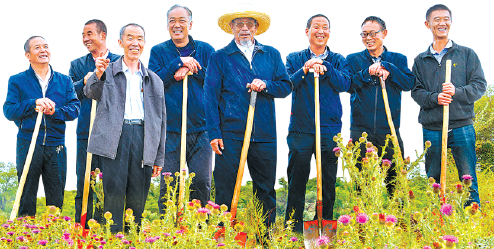
Three generations of workers in Northwest China's Gansu province, represented by "the six old men" on Babusha forest farm, have devoted themselves to combating desertification and protecting residents from the ravages of sandstorms.
Babusha, the largest sand dune at the southern edge of the Tengger Desert in Gansu, was a major source of sandstorms in the 1980s, when the southward movement of the desert devoured farmland and villages at a rate of 7.5 meters per year, affecting the livelihoods of more than 30,000 local inhabitants.
Now, the southward expansion has been stopped by a green belt that spans 10 kilometers in length and 8 km in width — a project that has lasted upward of 40 years.
The dramatic reversal stems from the decision made by "the six old men" back in 1981, when Guo Chaoming and five other villagers in Gulang county rented 5,000 hectares of sandy land and founded the Babusha forest farm. Their original aspiration was to prevent recurring sandstorms from destroying their crops. At the time, Guo, the oldest of the six, was already 61, while Zhang Runyuan, the youngest among them, was not yet 50.
The six men planted 667 hectares of saplings in the sandy land, with an expectation that 70 percent of them would survive. However, after the first sandstorm, no more than 30 percent of the saplings survived.
Through trial and error, the men discovered that saplings planted near grass clumps had a higher survival rate. The following year, they buried wheat straw around the tree pits to fix the sand, thereby successfully improving the sapling survival rate. And this approach — using a tree and a handful of grass to hold the sand and prevent wind erosion — became one of the most cost-effective and practical technologies for desertification control in China.
Planting trees in the desert is difficult, but maintaining them is even harder. To protect the trees they had painstakingly planted, the six men lived and worked on the site for years. They dug a pit in the sand, propped it up with wooden poles, and covered it with straw to create a rudimentary shelter. They used bricks to support a cooking pot, drank boiled water and ate steamed buns when hungry. Their living conditions didn't improve until 1983, when they built three rooms nearby with the help from the local forestry bureau.
In the eyes of the six men, the Babusha forest farm became their most precious possession. Even in the 1990s, when they faced financial difficulties and had no source of income, they couldn't bring themselves to cut down a single tree or pull up a single blade of grass to trade for money. Two of the six died of illness in 1991 and 1992. In 2005 and 2018, two others passed away. Their children and grandchildren took up the torch and have carried on the unfinished business of desertification control.
Across generations, the efforts of workers at Babusha forest farm have transformed vast sandy and windy tracts of desert into grassland and forest. The area of sand fixation, forest cultivation and grassland protection has surpassed 30,000 hectares, according to official data. Within the protected area of the Babusha forest farm, vegetation coverage surged from under 3 percent before management to more than 75 percent presently.
The determined efforts of "the six old men" and three generations of workers to turn the desert into an oasis earned them the titles of "Model of the Times" and "Most Beautiful Fighters" in 2019.






- PLA's Southern Theater Command conducts routine drone training near China's Dongsha Island
- PLA Eastern Theater Command monitors US naval vessels transiting Taiwan Strait
- Losar warmth in a new home
- New carrier rocket built by Beijing company fails in maiden flight
- Toxic gas leak in Anhui classified as major work safety liability accident
- Xiamen Marathon runners banned for smoking on course