Retelling a romantic legend
White Snake tale evolves into modern formats, with more emotion and contemplation, Xu Fan reports.










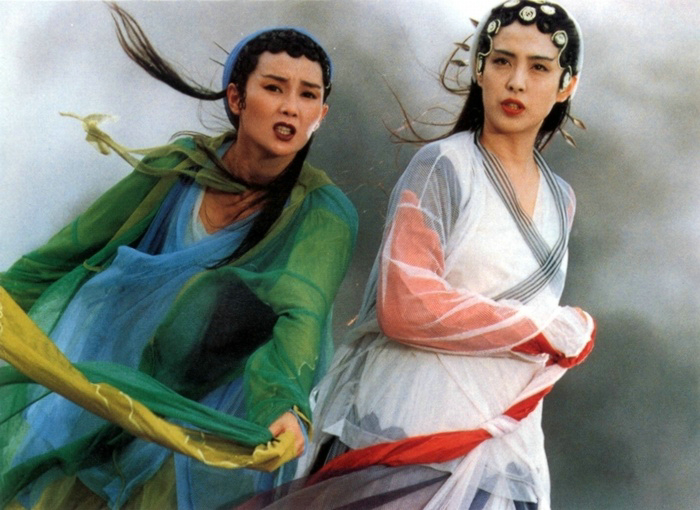
Updated with time
"In the earliest versions of the White Snake legend, the snake spirit was depicted as an evil monster. The story carries a strong admonitory message — warning men not to be tempted by their desires as it may lead to life-threatening consequences," says Wang Yong'en, a professor at the School of Theater, Film, and Television at the Communication University of China.
Some researchers believe that Gu Shenzi's novella collection Bo Yi Zhi (The Monstrous Stories) written during the Tang Dynasty is one of the earliest prototypes. In the story, Li Huang, a government official's nephew, encounters a beautiful widow in Chang'an, the capital of the dynasty (now Xi'an, Shaanxi province). After a successful courtship and living with the widow for three days, Li returns home and falls ill. He later discovers that his body has melted into liquid, leading to his death. The woman turns out to be a snake demon.
But what laid the foundation for most remakes in modern society is Jing Shi Tong Yan (Stories to Caution the World), a collection of short stories compiled by writer Feng Menglong during the Ming Dynasty.
"The story still centers on the theme of human resistance to sexual temptation but its conclusion introduces an emotional dimension to the White Snake demon, thereby adding a human interest element," Wang remarks.
By relocating the story to Hangzhou in Zhejiang province, then known as Lin'an, the capital of the Southern Song Dynasty (1127-1279), Feng's narrative follows Xu Xuan, a handsome but impoverished man. Bai Niangzi, the white snake demon, schemes to make him marry her because she finds Xu attractive.
But their tranquil and harmonious life is disturbed by Fahai, a powerful Buddhist monk. Showcasing his cowardliness and coldness, Xu betrays his wife and traps Bai with a magic bowl given by Fahai. He then becomes a monk, seeking alms to build a seven-story pagoda to suppress the snake demon. Xu Xuan was changed to Xu Xian in later works since the Qing Dynasty.
Xiaoqing, depicted as a green snake spirit 500 years younger than the White Snake demon in most subsequent adaptations, is portrayed as a massive black carp up to 3.3 meters long in Feng's tale.
"When the snake demon is trapped, she turns her head and looks deep into Xu's eyes, expressing sadness and surprise," says Wang.
This nuance, unlike the lust and desire in the Tang Dynasty version, is largely attributed to Feng, the talented and charismatic writer who staunchly advocated for natural emotions such as love, even though it was considered indecent in feudal society. In ancient China, young couples often entered into marriages arranged by their parents and matchmakers, not meeting their future spouse until the wedding.
With further adaptations spanning from the Qing Dynasty to the early 20th century, the legend has been enriched with detailed elaborations and infused with elements reflecting each era.
In later retellings, scriptwriter Fang Chengpei's Kunqu opera script Leifeng Ta (The Leifeng Pagoda), first published in 1771, introduced a new, iconic scene — the White Snake summons a flood to submerge Fahai's Jinshan Temple, compelling the monk to release the captive Xu.