Spring Festival, the bond of Chinese
Traditional new year a mosaic of society, Zhou Huiying and He Chun report.










Spring Festival's global influence is increasing as more countries and regions designate it as a legal holiday. Approximately one-fifth of the global population now celebrates the festival in various forms.
On Dec 4, UNESCO inscribed Spring Festival — the social practices of the Chinese people in celebration of their traditional new year — on the Representative List of the Intangible Cultural Heritage of Humanity.
The decision was made in recognition of the festival's colorful mosaic of social practices, rituals and cultural elements that engage the entire Chinese society.
"One of the special values of Spring Festival is its role as an emotional gathering for the Chinese people, serving as a powerful force of cohesion," said Xiao Fang, professor and director of the Department of Anthropology and Folklore at the School of Sociology, Beijing Normal University. "Additionally, Spring Festival marks a transition between the old and the new, symbolizing the renewal of time consciousness among the Chinese."
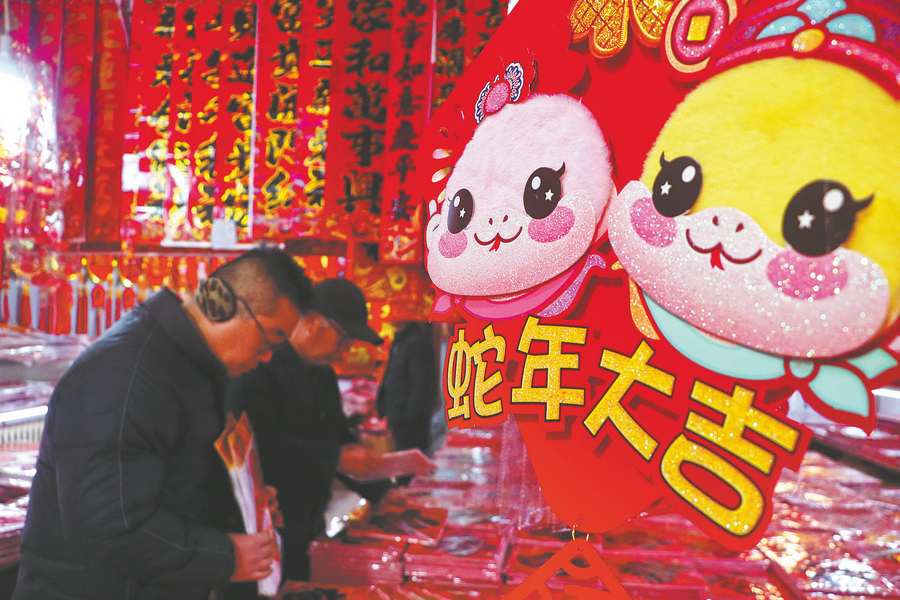
Xiao explained that before the Ming Dynasty (1368-1644), people hung peach charms at their doorways to ward off evil spirits. Over time, the charms were replaced with couplets, often containing auspicious phrases reflecting hopes and aspirations.
According to the professor, the customs of bidding farewell to the old year mainly include cleaning, gathering and greeting.
The family reunion tradition is the highlight of the Chinese New Year holiday, serving as a key part of the traditional ritual and the climax of the celebrations, according to Xiao.
"Although menus vary, the dishes served during the Chinese New Year's Eve dinner are symbolic, emphasizing auspicious meanings whether in the northern or southern regions of China," he said.
Giving red envelopes with money, known as "lucky money", is a common tradition during Chinese New Year, where elders give blessings to younger family members.
"Children eagerly anticipate receiving red envelopes, which have been popularized since the Ming and Qing dynasties (1368-1911)," Xiao said. "Children use the money from red envelopes to make their own purchases."
Zhang Li in Nanning, Zhao Ruixue and Li Tingting in Jinan, and Zhu Youfang in Changsha contributed to the story.
Contact the writers at zhouhuiying@chinadaily.com.cn