


Epic tale remains a story worth telling
Legendary king's exploits continue to resonate across the highlands in western and northern China, Deng Zhangyu reports.










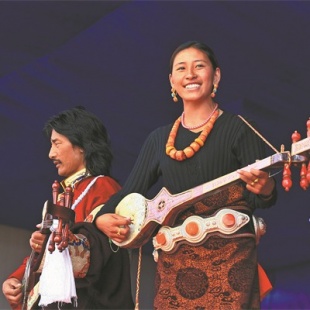
"A decade ago, performers would simply sing verses from the Gesar epic while seated or standing, often found in pastoral areas," he says. Today, however, these guardians of the Gesar epic tradition can be seen in teahouses, restaurants and theaters, thanks to sustained support from governments at all levels.
The Epic of King Gesar, passed down orally by singers and storytellers on the Qinghai-Tibet Plateau, is considered one of the longest "living" epics in the world. For centuries, storytellers have continued to sing it, weaving their own narratives into the ancient tale. It was inscribed on the UNESCO Representative List of the Intangible Cultural Heritage of Humanity in 2009.
The legend, dating back to the 11th century, recounts the adventures of King Gesar, a divine warrior who banishes demons, aids the vulnerable and unites the tribes.
"The structure and outline of the story are the same, but each storyteller brings his or her own unique version, enriched by individual experiences," says Sonam Tashi, who published 26 volumes recording various versions told by 26 storytellers last year.
A blend of history, myths, proverbs and folklore, the story of Gesar is regarded as an "encyclopedic" epic that integrates the culture, economy, customs and morality of many ethnic groups in China, including the Tibetan, Mongolian, Tu and Naxi.
In 2019, President Xi Jinping watched a group of singers performing excerpts from the Gesar epic at Chifeng Museum during an inspection tour of North China's Inner Mongolia autonomous region.
He stressed the importance of preserving and promoting the culture of ethnic groups. After talking with the performers, Xi pointed out that China is a unified multi-ethnic country, and the Chinese nation has been formed through continuous exchanges and integration among the 56 ethnic groups.