


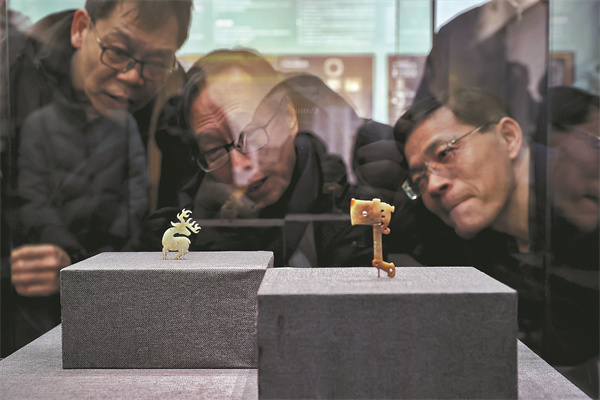
Exquisite bronze artifacts, ranging from tall, slender wine vessels to large, ornate wine containers, along with their elaborate production illustrations, give visitors a chance to appreciate the intricate patterns and technical mastery of ancient Chinese artisans.
About 20 of those ancient relics highlight the Marvel of Bronze section of the ongoing Technological Archaeology and Heritage Protection Exhibition that will last through to June 2 at the Chinese Archaeological Museum in Beijing. The section vividly showcases how those works of art were made, beginning with ore processing to metal and then casting with piecemolds.
"Modern tools like X-ray imaging and metallographic analysis have helped us study bronze artifacts in detail," says Liu Yu, a researcher of the technological archaeology and cultural heritage protection lab, of the Chinese Academy of History.
Traditional and modern methods were then applied to restore the bronzes, ensuring they retain their historical integrity, she adds.
This unit provides a comprehensive look at the entire life cycle of ancient Chinese bronze production, from mining and alloying to casting, as well as modern restoration, Liu says.
Visitors can appreciate the sophistication of ancient Chinese metallurgy, such as intricate patterns and artisans' precision.
"One of the most distinctive features of Chinese bronze craftsmanship is the use of piece-mold casting. Unlike Western traditions, which relied on forging and lost-wax casting, ancient Chinese artisans used clay molds to create intricate ritual vessels," Liu explains.
Piece-mold casting allowed for the creation of highly detailed and complex ritual vessels, which played a central role in Chinese ceremonial and political life, she adds.
A model of the vessel was made, and clay molds were pressed around it. These molds were assembled into a whole before molten bronze was poured in. Once cooled, the mold was broken away, and the vessel was cleaned and polished.
"The ancient craft was so extraordinary that you can barely find the traces of assembly, such as pouring gates and risers (a reservoir built into a metal casting mold to prevent cavities), or mold lines on the surface," Liu adds.





