


True to its name, Wutai Mountain Map illustrates two pilgrimage routes leading to the sacred mountain — one stretching from present-day Taiyuan in Shanxi province, and the other from present-day Zhengding county, Hebei province — covering approximately 160 and 260 kilometers, respectively. The map vividly portrays everything and everyone along these routes, from peasants trudging home with bundles of firewood, to lay believers erecting thatched tents in quiet valleys for moments of temporary meditation, and foreign envoys, their camels and horses laden with tributes, making their way toward a mountain temple.
The topography, rendered primarily in green and light brown, evokes the aesthetic of qinglyu shanshui — the "blue-and-green landscape" style of Chinese painting that emerged in the 5th century and flourished during the Tang Dynasty.
"The colors all come from natural pigments — turquoise for green, lapis lazuli for blue, cinnabar for red, kaolin (also known as Chinese clay) for white, and real gold for the gleaming gilt," says Zhong.
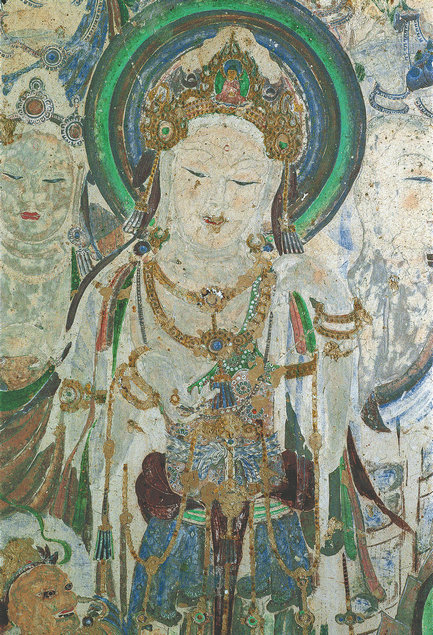
One figure who has received more than a few touches of gold is the Bodhisattva depicted in Cave 57 of the grottoes. Lavishly accessorized with gold bracelets and necklaces, as well as a gilded headdress the rich luster of which dances against the luminosity of her faint vermilion-colored skin, the Bodhisattva embodies the ideal of female beauty during the Tang Dynasty.
According to Zhong, as Buddhism made its way from India to China, the princely male image of the Bodhisattva gradually transformed into a more graceful and nurturing feminine form. Guanyin — the Chinese name for the Bodhisattva — literally means "One Who Hears the Cries of the World", a title befitting her divine role as the Goddess of Compassion. This transformation became especially pronounced during the Tang Dynasty, a time when women, as often seen in open and cosmopolitan societies, began to attain greater social standing.
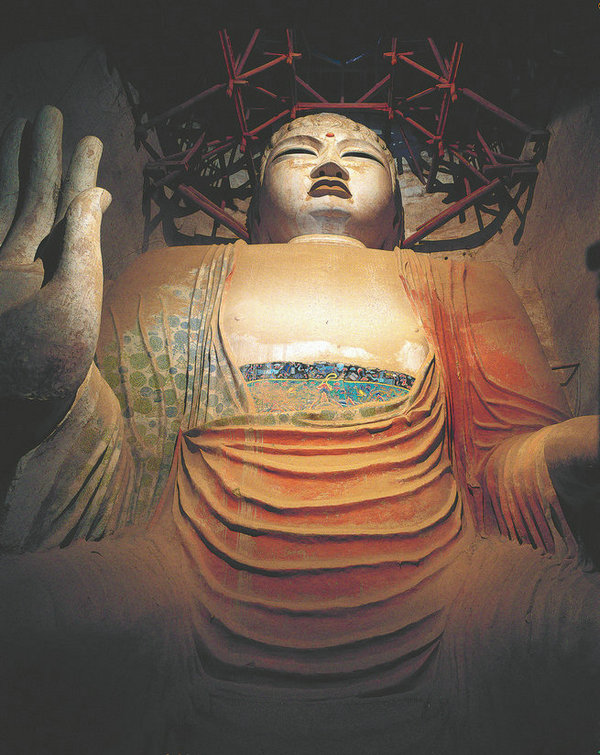
The trend was exemplified by the political ascent of Wu Zetian, who rose to heights unobtainable if not unimaginable for women both before and after her. Like any shrewd power player, Wu understood the importance of offering hope to her subjects. It was no coincidence, then, that she aligned herself with Maitreya — the future Buddha — who, according to Buddhist belief, will descend upon the world 5.67 billion years after the nirvana of Shakyamuni, the historical founder of Buddhism, to bring abundance and peace to all.





