China Travel Guide: Zhejiang









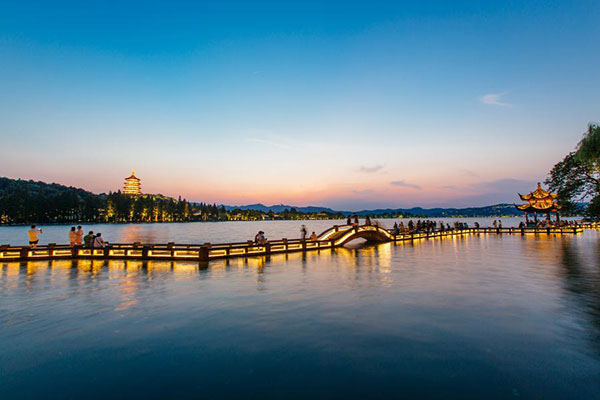
East China's Zhejiang province has long been a popular tourist destination for its picturesque landscapes and rich cultural heritage.
Zhejiang has much to offer, with UNESCO world heritage sites such as the West Lake in its capital Hangzhou, a major section of the Grand Canal and the archaeological ruins of Liangzhu.
Zhejiang is also well-known for its refreshing "longjing" (dragon well) tea and luxurious silk.
West Lake
West Lake, located at the west of Hangzhou city, is one of the top ten scenic spots in China and is among the first batches of national key scenic sites. In 2011, West Lake was included on UNESCO's World Heritage list.
Surrounded by mountains on three sides, the lake occupies ground area of 6.39 square kilometers. It is about 2.8 kilometers wide from east to west and 3.2 kilometers long from north to south. The total length around the lake is approximately 15 kilometers.
The surface of the lake is divided into five parts by Lonely Mountain, Bai Causeway, Su Causeway and Yanggong Causeway.
Small Yingzhou Islet, Mid-lake Pavilion and Ruangong Islet rise above the water in the middle of the lake, creating a picturesque view with the Leifeng Pagoda and Baochu Pagoda standing on the mountains beside the West Lake.
The Grand Canal
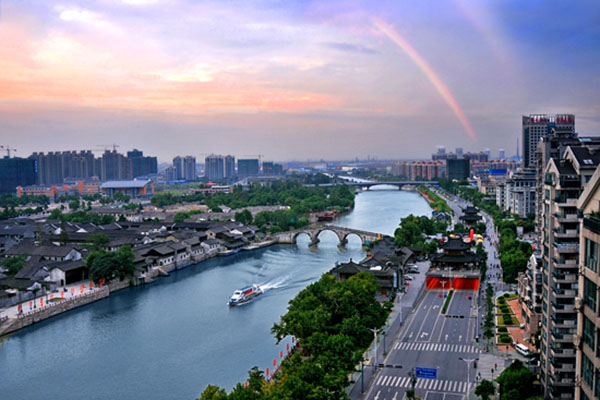
The Grand Canal, a vast waterway connecting the northern and southern parts of China, was listed as a UNESCO World Heritage Site in 2014.
The Grand Canal goes back 1,300 years and a part of its dates back to the 5th century BC. It starts in Beijing and ends in Hangzhou, passing through the city of Tianjin and Hebei, Shandong, Jiangsu and Zhejiang provinces. It links China's two longest rivers, the Yellow and the Yangtze, and has a total length of 1,794 kilometers.
In olden days, traffic on land depended on men and animals and was costly, slow, and small in scale, so large cargo was usually moved by water. The Grand Canal was originally intended for grain and luxuries; later, merchants began using it for commodities, turning the corridor into a prosperous economic belt.
Archaeological Ruins of Liangzhu City
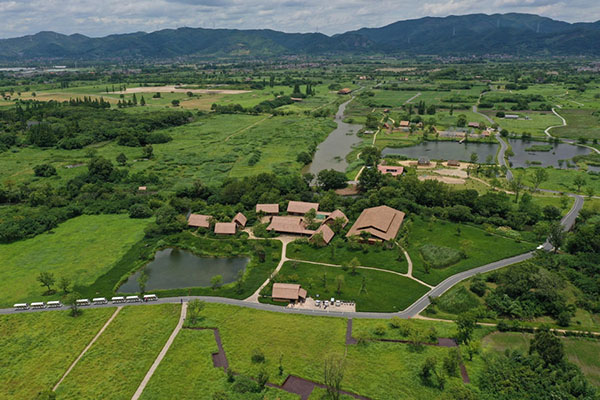
The Archaeological Ruins of Liangzhu City was inscribed on the UNESCO World Heritage List in 2019.
Located in the Yangtze River Basin on the south-eastern coast of the country, the archaeological ruins of Liangzhu (about 3300-2300 BC) reveal an early regional state with a unified belief system based on rice cultivation in Late Neolithic China.
The property is composed of four areas – the Area of Yaoshan Site, the Area of High-dam at the Mouth of the Valley, the Area of Low-dam on the Plain and the Area of City Site. These ruins are an outstanding example of early urban civilization expressed in earthen monuments, urban planning, a water conservation system and a social hierarchy expressed in differentiated burials in cemeteries within the property.