From fragmentation to alignment









The Global South is rewriting the rules of development aid to facilitate long-term transformation
The global aid landscape is undergoing a significant transformation. Once defined and dominated by Western institutions and priorities, this system is being reshaped by new actors, new expectations and new geopolitical realities. One of the most important and influential changes is the emergence of China as an alternative development provider, rewriting the way aid is conceived, delivered and valued in partnerships across the Global South.
This change is not about replacing one model with another. Its significance runs deeper than that. Fundamentally, it is about alignment: realigning development cooperation and assistance provision to the needs and aspirations of the Global South and aligning global partnerships with the values and imperatives of promoting sustainability, equity and peace central to the sustainable development goals of the United Nations.
For many decades, the rules and requirements of foreign aid have been set by Western countries, principally the United States, the United Kingdom and other Western European donors, led by the Development Assistance Committee of the Organization for Economic Cooperation and Development, institutions such as US Agency for International Development and the UK's now-defunct Department for International Development (DFID), combined with multilateral institutions such as the World Bank. The universal development model they promoted was grounded in conditionality, governance reform and technocratic planning. This model contributed development gains, in health and education for example, but has critical limitations that have intensified in recent years and deepened into a full-blown crisis.
Western aid is fragmented, politicized and out-of-touch with Global South recipient priorities. Indicative of this is the dismantlement of USAID under the "America First" doctrine of the Donald Trump administration. In parallel, the UK's aid budget will be cut from 0.5 percent to 0.3 percent of its GDP in 2027, and the DFID has been absorbed by the Foreign, Commonwealth and Development Office — signaling a pivot toward diplomacy over poverty reduction. The finance ministers of Germany and France have confirmed similar diversion of funds from aid to defense. In the US, the Trump administration ended USAID and put aid under auspices of the State Department, with the aim of harnessing aid as a tool for strategic competition with China.
The donor-funded active projects in sub-Saharan Africa often duplicated each other and some were disconnected. Not only is this inefficient, undermining effectiveness, it is also debilitating and disempowering, sapping limited financial, human and administrative resources, but also belief in the system. In practice, aid has reinforced dependency, rather than enabling autonomy.
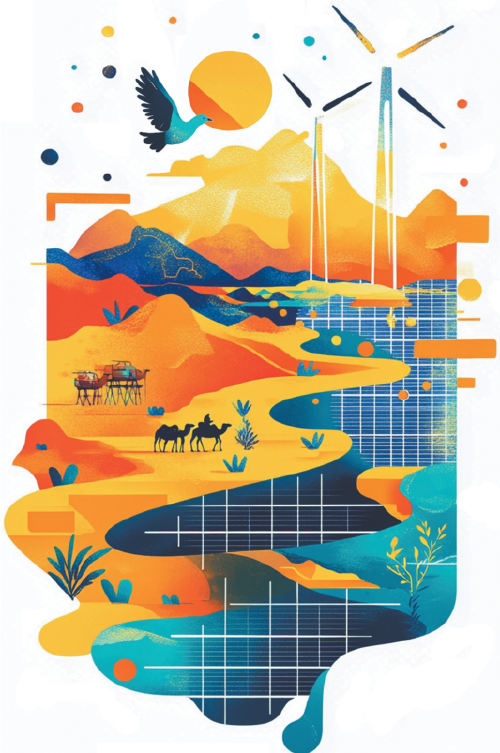
In this context, China has emerged as a new type of strategic development partner. Since the Belt and Road Initiative was launched in 2013, China has mobilized resources for infrastructure, energy and connectivity projects in the Global South. The focus has largely been on practical deliverables: bridges, roads, ports and power plants, often delivered ahead of schedule, within budget and without reformist strings attached, offering partner governments political space to define their development pathways. New quality productive forces are central to the Fourth Industrial Revolution development in the Global South. Recognizing and responding to this, China has integrated emerging technologies into its South-South cooperation, supporting the development of digital economies and e-commerce.
China's approach has growing appeal across the Global South. This ought not to be seen as a threat to the West, but rather as a wake-up call. Development aid is not a zero-sum game. The central issue is not China versus the West — it is fragmentation versus alignment. The Global South needs coordinated, respectful and equitable partnerships aligned with national priorities, facilitating long-term transformation. That means integrating the strengths of different models, fostering mutual learning and avoiding rigid ideological divisions.
China has a vital role to play in this, leading by example — demonstrating that projects maintain high standards of environmental sustainability, labor protection and local participation. The era of top-down, donor-driven development is fading. What comes next must be built on mutual respect, shared responsibility and strategic alignment. China's rise as a development partner has created new possibilities.
In a world increasingly shaped by the climate crisis, geopolitical instability and economic uncertainty, development cooperation is more vital than ever. But it must serve peace, not rivalry; empowerment, not dependency. Ultimately, development must be reclaimed, not as a technical problem to be solved from outside, but as a political and ethical project, grounded in local realities, informed by global solidarity and shaped by those most affected.
The present system is in profound flux and change. This incurs important costs, but also fresh opportunities. The choice isn't between Western aid or Chinese aid — it's between ineffective fragmentation and coordinated impact. As the development landscape enters a new era of geopolitical tension, the Global South is transitioning from passive recipient to strategic broker.
The future of global development will be shaped not in Washington or Brussels, but increasingly in Beijing, Rio de Janeiro, New Delhi, Johannesburg and Jakarta, among others. And the Global South is no longer just a recipient — it is a shaper of the rules.
The author is a senior research fellow and director of the Centre for Rising Powers and Global Development at the Institute of Development Studies in the United Kingdom, and a chair professor at International Development at China Agricultural University. The author contributed this article to China Watch, a think tank powered by China Daily.
The views do not necessarily reflect those of China Daily.
Contact the editor at editor@chinawatch.cn.