



Researchers help save Qilian's ecosystem
Monitoring and study of diverse factors go on in tough terrain









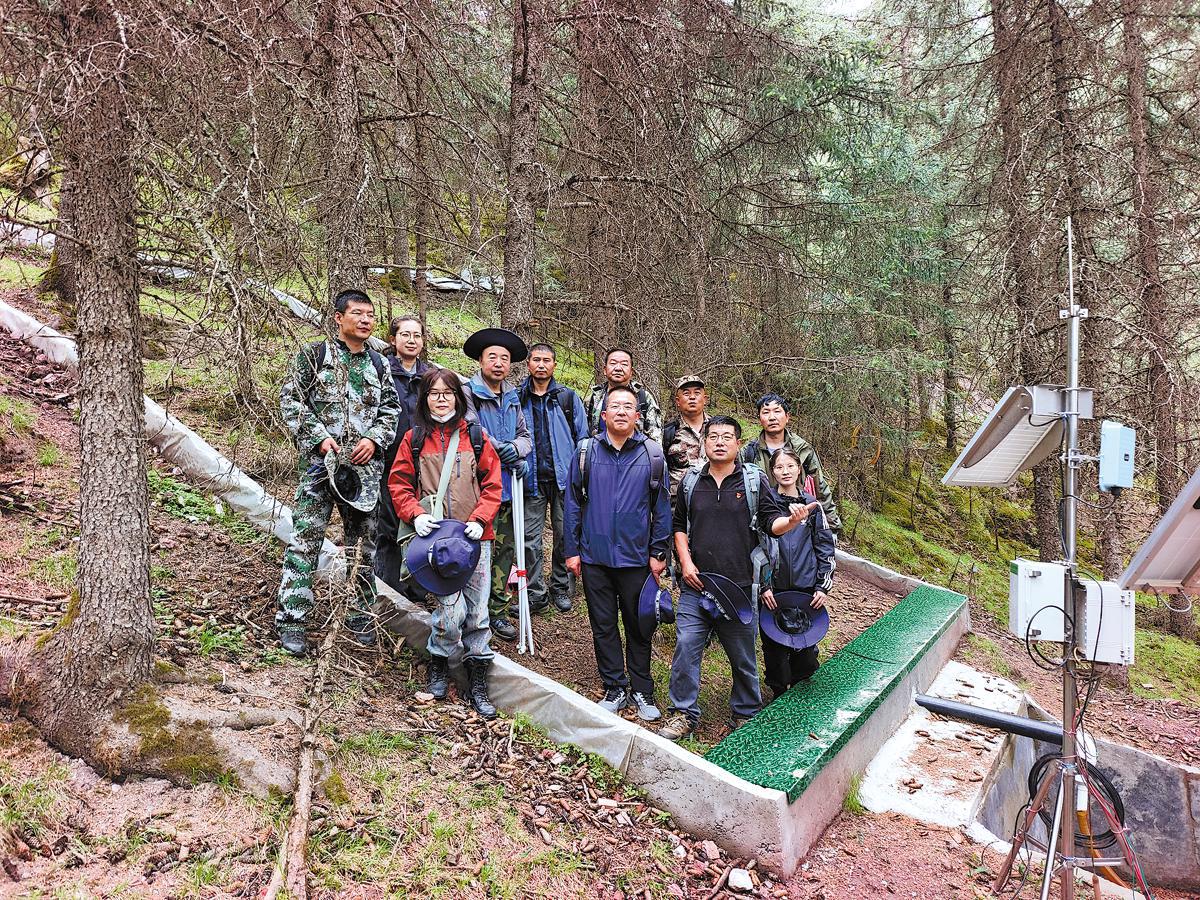
Two years later, Jing adapted to life there. "The transition from resisting working in this place to genuinely liking it was arduous, but once you make that shift, you develop a passion and affection for your work. This mindset allows you to approach any task with enthusiasm and dedication," he said.
One of Jing's most memorable field monitoring experiences occurred in 2012 when he led a team to conduct a high-altitude shrub survey at 3,800 meters. "The weather in the mountains is unpredictable, and forecasts were less accurate than today. We set off in sunny weather, but by the time we reached the mountain top, it was overcast, and soon it began to rain," he said.
The rain lasted five hours, reducing visibility to less than five meters. Jing and other members of his team were not only unable to work but were also trapped on the mountain. "In such high-altitude areas, the terrain is steep, with cliffs and meadows, and most of the ground is bare rock. A bit further down, there are shrubs about a meter high. Our communication was limited to a walkie-talkie, and we had to rely on over a decade of field experience to find our way down."
Despite being late June, the high-altitude area was bitterly cold, and the water and food they carried had frozen. The team lacked modern gear such as down jackets and wore only camouflage uniforms. "One young woman in our team, new to the job, began showing signs of hypothermia, which terrified me. I quickly gave her my wool vest to hold for warmth, which resolved the crisis," Jing said.
Two members of the team couldn't trek further down, so Jing led the main group to a flat area to wait while he climbed back to assist them. He ended up climbing 3,800 meters twice that day. By the time they returned to the station, everyone was soaked to the bone.
Jing said: "We all returned safely, but I vowed never to let such an incident happen again. It's crucial to check the weather forecast before setting out. This is not something to be taken lightly, and I must be responsible for everyone's safety."
Jing said that the greatest sense of accomplishment came when he completed the major monitoring conducted every five years and the minor ones done annually, especially when he finished writing the evaluation reports. "Watching the data transform into reports, and then submitting those reports to various levels of government, particularly the National Forestry and Grassland Administration, makes me feel that this work is incredibly worthwhile," he said.
"At least our persistence and efforts are meaningful. Over the decades, the nation has increasingly prioritized the ecological protection of the Qilian Mountains, which I believe is inseparable from our contributions."
The research institute has tackled over 100 critical issues and key technologies urgently needed for the ecological protection and restoration of the Qilian Mountains. In 2018, the institute collaborated with the Chinese Academy of Sciences to complete a report on the ecological changes of the Qilian Mountains.
The report indicated a significant trend of warming and wetting in the Qilian Mountain range, an extended growing season for vegetation, an overall increase in annual average vegetation coverage, and a slight rise in the multi-year average unit water conservation capacity.
In 2019, the institute conducted a comprehensive scientific survey of the ecological changes across the 800-kilometer stretch of the eastern, central, and western Qilian Mountains, resulting in a report.
Moreover, 95 percent of the ecological monitoring in the Qilian Mountains has been automated.
Jing is happy to see the continuous influx of young, fearless talent. The team includes six members born in the 1990s, making up about half of the total staff.
"In scientific research, you need not only to be thoughtful but also to invest immense passion to succeed," Jing often advises newcomers to the institute.
Contact the writers at xunuo@chinadaily.com.cn


