One Chinese emperor loved jade so deeply that he commissioned countless objets d'art from the finest craftsmen, composed poems about both ancient and contemporary pieces, studied its history, and even named 14 of his 17 sons with characters evoking ritual jade or its luminosity (the remaining three died young and were never named).
This emperor was Qianlong of the Qing Dynasty (1644-1911), China's last imperial dynasty, who lived from 1711 to 1799.
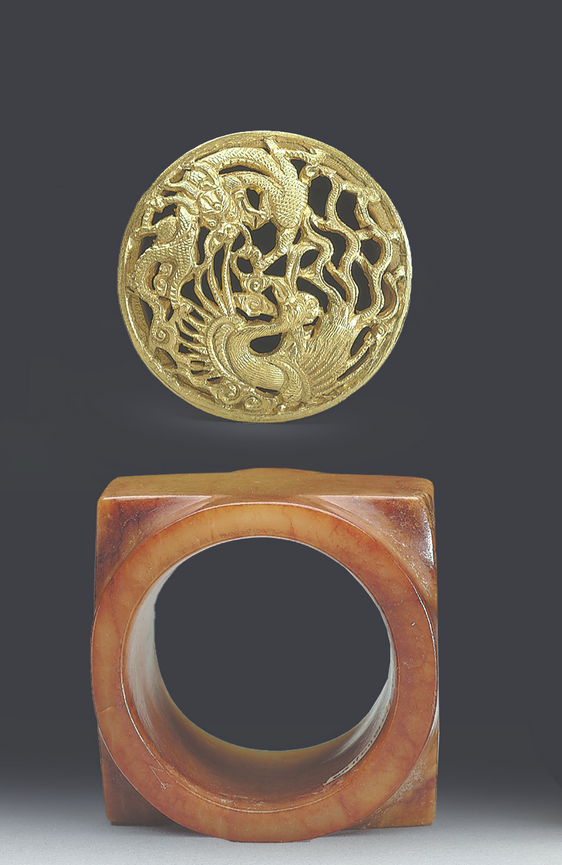
A striking example of his passion is his reinterpretation of the cong, a type of ancient ritual jade featuring a cylindrical tube encased in a square prism. Believed to reflect Chinese ancestors' cosmology, the cong served as a cultural emblem and a symbol of power and belief, especially during the later stage of the Liangzhu culture (3300-2300 BC) in the Yangtze River basin.
By all evidence, Qianlong did not fully grasp the significance of the Liangzhu cong. He was unaware that these were early examples of the cong — one of six ritual jade archetypes cataloged in the 3rd-century BC text The Rites of Zhou (Zhou referring to the dynasty that ruled 11th-3rd century BC). Instead, he saw them as gangtou, a term for a carriage part connected to the axle, and had this inscription added to some pieces, confident in his own judgment.
Yet, this misinterpretation did not diminish his admiration. Qianlong treasured his cong — some from Liangzhu, others from Qijia culture (2300-1500 BC) in the upper Yellow River region — and creatively repurposed them, adding metal liners and holed covers to transform them into brush holders or incense burners.
Today, while some pieces remain in Beijing's Forbidden City — where Qianlong spent almost his entire life — others are preserved in museums outside of Beijing, including Taipei's Palace Museum. (The Forbidden City, imperial palace since 1420, became a museum in 1925.)
In his 2009 book on Qianlong, Mark Elliott, Harvard professor of Chinese and Asian history, described him as a "son of heaven, man of the world". Qianlong, the second longest-reigning Chinese emperor, abdicated in 1796 after 60 years on the throne, partly to honor his revered grandfather, Emperor Kangxi, who ruled for 61 years.