Traditional heritage living in harmony









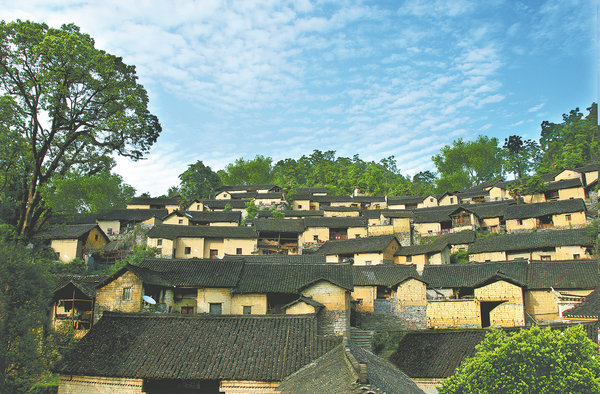
On our way to a private Miao ethnic museum, we stumble upon a local fair in Shanjiang town, Fenghuang county in Hunan province. This traditional fair takes place on dates that include a three or an eight on the lunar calendar.
Elderly women carrying bamboo-woven baskets on their backs come to the fair to purchase food, utensils, clothing, decorations, pesticides, and more.
Along a small road adjacent to the main street, a line of fortunetellers sits ready to welcome business. Nearby, two vendors sell secret medicines purported to cure all kinds of ailments.
In the section dedicated to traditional clothing, I meet a woman examining a piece of traditional Miao embroidery.
Long Mingfang, a 32-year-old native folk singer and a representative inheritor of the Miao folk song intangible cultural heritage, holds an embroidery work approximately 100 years old. It's a delicate piece rarely seen today, which she inherited from her grandmother.
She shows it to the vendors to illustrate what she is searching for.
"This is for daily wear. You can see many of us wearing ethnic clothing here," she says.
"For special occasions like festivals or weddings, we also wear intricate silver decorations."
At the museum, Long Qingfeng, a 43-year-old guide, shows me the Miao people's tradition of deity worship in the region. The Miao are animists, although the pair of Nuogong (male) and Nuomu (female) are revered as the most powerful deities.
She explains that the altar for votive ceremonies is displayed for visitors, but usually, after the ceremony, the hanging paper decorations are burned.
I must admit that before visiting this worship hall, I avoided such places because many, with their idols, appear intimidating, even in photographs.
However, this residence, which was once a mansion for the local head of the Miao ethnic group, with many collections of items from the traditional lives of Miao people, embodies their philosophy of living in harmony with nature. It feels remarkably comfortable, even on a hot afternoon.
Like the Miao people in Shanjiang, the Tujia and Dong ethnic groups in western Hunan also share a deep connection to their cultural traditions. They live harmoniously together, making it one of the most culturally diverse regions in China.
He Chun contributed to this story.