



Nation to prioritize innovation, AI in 2026 economic agenda
Proactive policy in pipeline to step up tech upgrade, spur industrial resilience









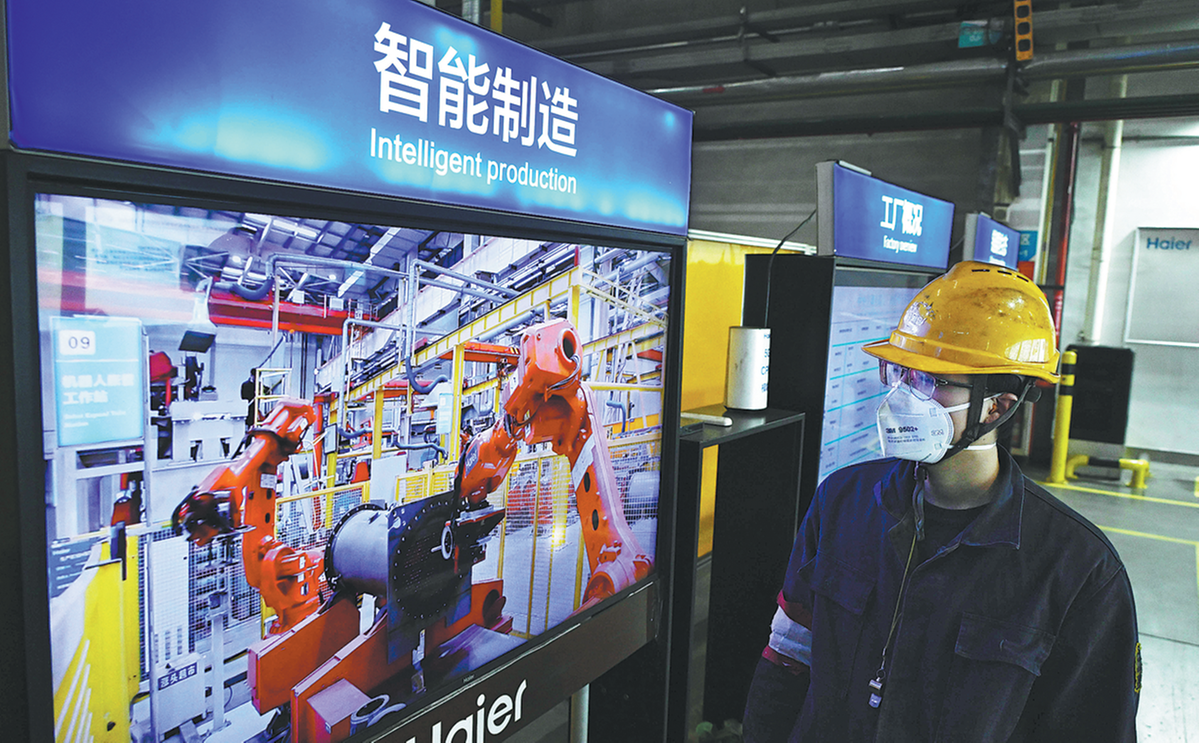
China is expected to place technology and new quality productive forces, such as artificial intelligence, at the center of its economic policy agenda for 2026 at the upcoming Central Economic Work Conference, said leading economists and industry experts on Monday.
As the high-level meeting will set the tone for the coming year's economic development, they said that Beijing is preparing a more proactive policy to accelerate technological upgrading, strengthen industrial resilience and secure new economic growth drivers.
Ming Ming, chief economist at CITIC Securities, said: "Policy direction will likely turn more active and forward-looking. Boosting domestic demand, advancing technological innovation, coordinating fiscal and monetary tools and defusing property sector risks are likely to secure attention at the conference.
"Technology will likely take unprecedented prominence with early planning on AI, advanced manufacturing and frontier technologies to ensure a strong start to the new planning cycle."
Chinese authorities have recently signaled similar stances. Last week, Zheng Shanjie, head of the National Development and Reform Commission, said China will adopt "extraordinary measures" to push for decisive breakthroughs in critical technologies and to integrate science and industry more tightly across entire supply chains.
The message aligns with Beijing's long-term goal of reducing dependence on foreign technologies amid intensifying competition with the United States. China's investment in high-tech manufacturing rose more than 10 percent year-on-year in the first three quarters, outpacing overall fixed-asset investment.
Zhang Junkuo, a member of the 14th National Committee of the Chinese People's Political Consultative Conference and former deputy head of the Development Research Center of the State Council, said the shift from follow-up innovation to frontier innovation is "the only path forward" in the new stage of development.
Frontier innovation, he said, must address two urgent tasks: breaking foreign bottlenecks to strengthen industrial security, and boosting China's relatively weak basic research capacity to secure long-term scientific momentum.
"The key is to form institutions and ecosystems that match the demands of frontier innovation. We must advance reforms in education, science and talent together, improve the efficiency of the national innovation system and balance self-sufficiency with open cooperation," he said.
Xiong Yuan, chief economist at Guosheng Securities, said that "strengthening industry" is likely to remain another top priority as China seeks greater self-reliance in core technologies, such as semiconductors, advanced materials and industrial software.
Under the blueprint for the 15th Five-Year Plan (2026-30), policymakers are expected to accelerate the construction of a modern industrial system anchored by advanced manufacturing. That includes upgrading traditional sectors with smart technologies including AI.
Policymakers are also pushing to expand strategic-emerging industries ranging from electric vehicles to advanced robotics, which accounted for nearly 14 percent of GDP in 2024.
The fourth plenary session of the 20th Central Committee of the Communist Party of China also stated that future sectors such as quantum technologies, biomanufacturing, hydrogen and fusion energy, brain computer interfaces, embodied intelligence and 6G will get more support.
High-tech sectors are showing momentum, with exports of electric vehicles, batteries and solar products rising faster than overall shipments.
Wang Peng, a researcher at the Beijing Academy of Social Sciences, said policymakers are expected to reinforce confidence in China's long-term technological trajectory at the upcoming conference.
"By spelling out a clearer pathway for cultivating new quality productive forces, the leadership can help anchor expectations for 2026 and send a strong signal that China's growth model is shifting toward innovation-driven development," Wang said.
chengyu@chinadaily.com.cn


















