Chinese legend White Snake reimagined through experimental theater in New York









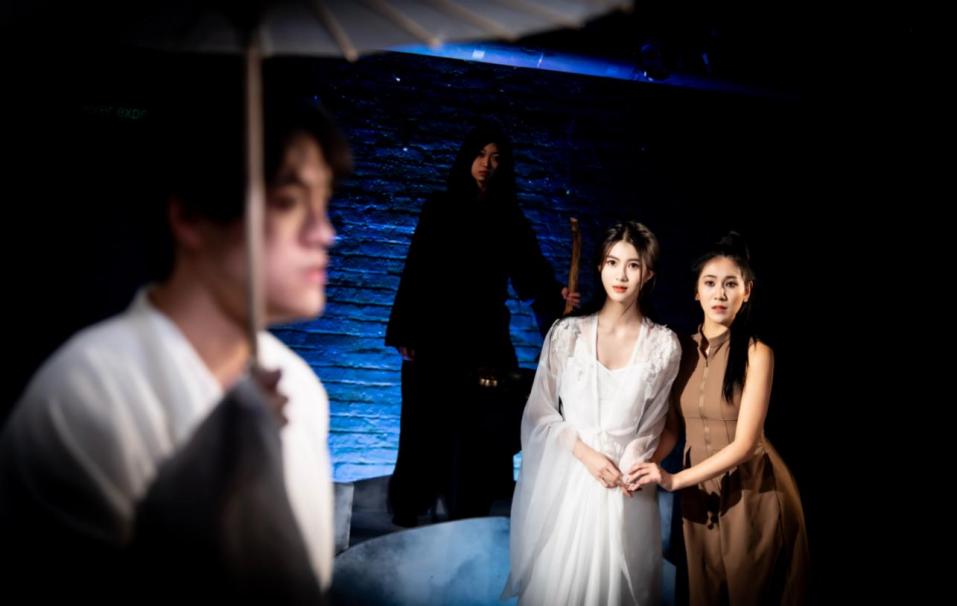
The Chinese folktale The Legend of the White Snake has been reimagined by an experimental theater in New York.
Qing Bai: Innocence, a stage production inspired by the ancient tale and created by youth Chinese theater-makers and crew, ran Friday through Sunday at New York's HERE Arts Center, following its US East Coast tour with performances at Brown University and Yale University.
The production drew on The Legend of the White Snake — a love story between a human and a snake spirit that reflects on themes of love, sacrifice and social norms — and used movement, sound and gesture in an experimental theater framework to explore emotional commonalities between Eastern and Western cultures.
Ophelia He, who played the snake and co-wrote the production, said the New York staging was meaningful to her.
"I feel very honored to bring The Legend of the White Snake, a beautiful piece of traditional Chinese culture, to the theater in New York," she told China Daily.
She said that the creative team adopted an "ensemble approach", moving away from a conventional lead-supporting character structure. The four central figures in the show were developed with equal narrative weight, each following a complete story arc.
"The characters were conceived as distinct archetypes. Even without prior knowledge of Chinese tradition or the Chinese language, audiences could still feel the emotional struggles and identities of the characters through performance and physical expression," He added. "This story can be applied to stories under different cultures. The emotions are universal."
Director and co-playwright Tara Nyingje said the work centers on an experimental approach.
"I'm especially drawn to Chinese folk legends and to exploring how stories people think they already know can be reimagined through different forms of expression," she said. "It can be played in so many different ways and has many different understandings."
Nyingje said that performing in Mandarin shaped both vocal delivery and emotional expression, while the team used English surtitles projected above the stage to help non-Chinese-speaking audiences follow the performance. However, the translation avoided contemporary spoken English.
"The original dialogue sits between classical and modern Chinese; the translation process presented some challenges. It did create some difficulties," Nyingje said. "To preserve the historical tone, the English was rendered in a more archaic tone."
While acknowledging that the language may sound "a bit awkward" to modern ears, Nyingje said the approach was intentional in conveying "a sense of the period and the choices behind the wording" to blend modern and ancient story together.
Work on the production started in September.
"We want to try and work more on Chinese traditional topics overseas," He said.
She said her engagement with Chinese material was partly shaped by her academic experience in the West. The more she studied Western traditions, the stronger her impulse became to question her own cultural roots.
"This makes me look back and explore the underlying core of my own culture," He said.
"The Legend of the White Snake is a folktale without a definitive version, and the story has evolved through retellings across multiple Chinese dynasties. Changes in language and storytelling conventions, particularly in later vernacular narratives, continually reshaped the story. We want our work to continue through a contemporary dialogue with earlier interpretations," He added.
"Performance methods are primarily tools. No matter if it's theater or film, it's just a form, an outer shell," Nyingje said. "The ongoing interest always lies in integrating Chinese cultural elements into experimental theater and testing how they could be combined."