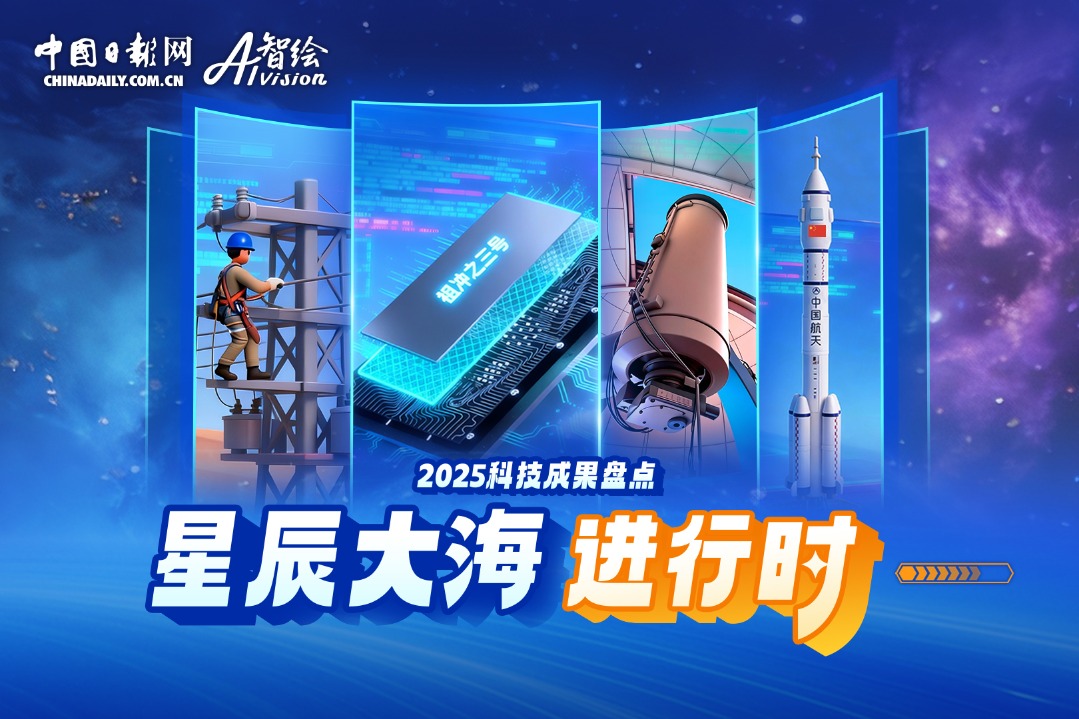
Growth charted in China's geospatial information sector









China's geospatial information sector, a crucial component of digital mapping and positioning, is nearing a scale of 1 trillion yuan ($143 billion), the Ministry of Natural Resources said on Tuesday.
According to the ministry, by the end of 2025, the industry is expected to exceed 900 billion yuan in output, representing a more than 30 percent growth compared to 2020. The sector employs more than 4 million people.
Central to this industry is tianditu.gov.cn, the national platform for geospatial information services operated by the ministry. As of Thursday, approximately 1.48 million users had registered on the platform, which has authorized about 1.13 million applications and handled 1 billion service interface access counts daily, on average. It supports over 7,000 government users and around 33,000 enterprises, playing a vital role in developing a digital China.
"Initially a basic map service, the platform has evolved into a comprehensive natural resources service base," said Chen Ping, an official from the ministry, adding that the platform integrates information on land use planning, geological surveys, forestry, grassland and marine resources onto a single digital canvas.
"The geospatial information also helps foster emerging industries such as developing a geospatial information security application space for autonomous driving," Chen said.
Under a pilot program led by China's State Council, six cities, including Beijing, Shanghai and Chongqing, are exploring the secure application of high-definition maps for intelligent connected vehicles. This initiative aims to build a standardized system for autonomous driving maps, which are widely used to support autonomous driving below level 3 on ordinary roads across major Chinese cities, Chen added.
According to the taxonomy of driving automation for vehicles released by the State Administration for Market Regulation, autonomous driving is categorized into six levels. For levels 0 to 2, the human driver must retain in control and bear full responsibility for the vehicle's operation. Starting from level 3, the autonomous driving system takes over as the primary operator of the vehicle.
Several key initiatives in geospatial information support the low-altitude economy. Zhu Guoming, deputy director of Guangdong province's natural resources department, said the Beidou high-precision positioning service has enabled drones to conduct smart grid inspections at low altitudes for the China Southern Power Grid.
To ensure data security related to the low-altitude economy, the province has implemented review requirements for flying car navigation electronic maps, completing several low-altitude navigation map reviews, Zhu added.



- Growth charted in China's geospatial information sector
- Asteroid named after Chinese botanist Kuang Tingyun
- Fujian coast guard conducts law enforcement, control drills near Taiwan Island
- PLA drills 'encircle' Taiwan to demonstrate ability to cut off energy supply: Expert
- PLA practices seizure of key ports during drills in waters to east of Taiwan
- China becomes the world's 4th manufacturing power