



Shanghai readies launch of innovative 2D chip









China has launched its first engineering demonstration line for a new generation of microprocessors made from ultrathin materials, a move that could eventually challenge the dominance of traditional silicon chips.
The production line, located in Shanghai's Pudong New Area, is scheduled to begin full-scale production by June. It marks the transition of the "WUJI" microprocessor — the largest of its kind globally — from a laboratory concept to a manufactured product.
For decades, the computer industry has relied on silicon to build transistors, which act as tiny on-off switches for data. However, as chips get smaller, silicon hits physical limits that cause it to leak energy and overheat. The WUJI chip instead uses a "two-dimensional" material called molybdenum disulfide. Unlike traditional materials, these 2D materials are only a few atoms thick, allowing electrical signals to move more efficiently while generating significantly less heat.
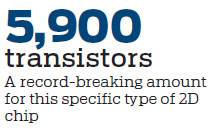
The new chip integrates a record-breaking 5,900 transistors. While this is small compared to the billions of transistors found in high-end smartphone chips, it far surpasses the previous world record of 115 for this specific type of 2D technology. Researchers say the more transistors a chip contains, the greater its data processing capability.
The project is spearheaded by Shanghai Atomic Technology, a firm focusing on "beyond Moore" technology. This term refers to innovations that continue to improve computing power even as traditional silicon shrinking slows down.
The company was founded in February 2025 by Bao Wenzhong, a researcher from Fudan University.
Using a 32-bit architecture — essentially the blueprint that tells a chip how to function — the WUJI can perform addition and subtraction on numbers up to 4.2 billion and handle gigabyte-level data storage. Most importantly, the team managed to achieve incredibly low power consumption. This is vital for the future of artificial intelligence, which currently requires massive amounts of electricity for training and reasoning. Energy consumption remains a major constraint on expanding global computing power.
Bao said the firm aims for the demonstration line to be fully operational by June. Following that, they plan to achieve a 90-nanometer equivalent silicon-based process this year. The team has set ambitious goals to reach 28-nanometer processes by 2027 and even 5-nanometer or 3-nanometer processes by 2028. In chip manufacturing, a smaller nanometer number generally represents a more advanced and powerful chip.
The development of integrated circuits is one of Shanghai's three leading industries. Zhai Jinguo, deputy director of the Science and Technology Commission of Shanghai Municipality, said the city is systematically deploying strategies to nurture this emerging industry. Shanghai is accelerating efforts to overcome technical barriers by connecting academic institutions and venture capital to provide funding and talent alignment.
By supporting leading enterprises in forming innovative alliances, the city aims to create a complete industry cycle that moves 2D semiconductors from the research phase to mass application.


Today's Top News
- Sowing protection of environment in young minds
- Second Chinese-built large cruise ship to sail soon
- Xinjiang will only prosper further under new law
- Smart factories power China's growth rebound
- Effort targets irregular stock selloffs
- Initiative gains fresh backing as risks grow


