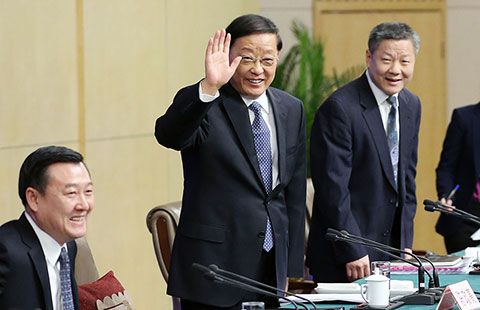
NANNING -- Thongsing Thammavong, Prime Minister of Laos, indicated willingness to boost agricultural cooperation between China and Laos during his visit to the ongoing ninth China-ASEAN Expo in Nanning, capital of southwest China's Guangxi Zhuang autonomous region.
After touring agriculture centers in Guangxi, he said Laos will provide a better environment for Chinese agricultural investment.
In July, the Laotian government invited Chinese agriculture expert Liang Tianyin to the country to construct a food production center, providing him with 50 hectares of farmland and helping him to build the center.
The project is part of China's efforts to meet its demand for food, as its massive population has made securing food for present and future generations a difficult task.
Southeast Asia represents the world's greatest grain-producing area, with rice exports from Thailand, Vietnam, Laos, Cambodia and Myanmar totaling more than 20 million tonnes, or two-thirds of the world market share, according to the International Grain Council.
Yang Yafei, a researcher with the Guangxi Academy of Social Science, said agriculture will be a key field for cooperation between China and ASEAN in the 21st century.
According to statistics given by agricultural scientist Yuan Longping, China now is trying to ensure food safety for its 1.3 billion people.
Yuan said China has a total of 29.5 million hectares of rice-planting area, with 60 percent of the area being used to grow hybrid rice, which has an average output of 7.3 tons per hectare.
Since the start of China-ASEAN cooperation, hybrid rice and rice-planting techniques from China have seen a promising future in developing countries, including Vietnam, Cambodia and Brunei.
Li Danting, vice director of Guangxi Rice Research Institute, said many Chinese enterprises and research institutes have built agricultural demonstration centers in southeast Asian countries, as many of the countries have relatively poor food production capabilities.
An official with the Department of Agricultural Rural Development in Vietnam's Ha Giang province said the country has 36,000 hectares of rice-planting area with an output of 200,000 tons of rice annually.
Most of the rice is hybrid rice from China, the official said, adding that local rice output is still low and will require more Chinese agricultural know-how.
China has sent several agricultural expert groups to East Timor since January 2008 to help locals build demonstration fields for super-hybrid rice, which is expected to be able to produce eight tons of rice per hectare.
The government of East Timor has also made a plan to promote Chinese super-hybrid rice, aiming to feed the country independently in five years.
"The supply and demand of grain in southeast Asia is imbalanced, as Thailand, Myanmar and Vietnam export rice while Indonesia, the Philippines and Malaysia have to import rice," said John Wong, a researcher with the East Asian Institute at the National University of Singapore.
"The situation indicates relatively low food security in the area," he added.
Lv Ronghua, deputy director of the International Cooperation Department of the Guangxi Academy of Agricultural Science, said China is both the world's largest producer and consumer of food, adding that food security cooperation between China and southeast Asia will be important in terms of maintaining global food security.

Copyright 1995 - . All rights reserved. The content (including but not limited to text, photo, multimedia information, etc) published in this site belongs to China Daily Information Co (CDIC). Without written authorization from CDIC, such content shall not be republished or used in any form. Note: Browsers with 1024*768 or higher resolution are suggested for this site.
License for publishing multimedia online 0108263 Registration Number: 130349