Comments
  Print
Print  Mail
Mail  Large Medium Small
Since 2010, the city has invested 54.3 billion yuan ($8.9 billion; 6.5 billion) in emerging industries, which accounts for more than 52 percent of Zhangjiagang's total industrial investment over that period.
The outlay is showing early dividends. In the past two years, revenue of companies in the emerging industries category has risen 30 percent a year.
Last year, the output value of emerging industries was 182.5 billion yuan, about 40 percent of the city's total industrial output. By 2015, it is expected to account for 50 percent.
Yao says traditional industries rode a boom driven by insatiable market demand after the country opened up in the 1980s. Between 2000 and 2008, Zhangjiagang's revenue rose from 1 billion yuan to 10 billion yuan.
But the days of easy money are now a thing of the past.
"The market has been saturated, and margins in traditional sectors have been affected for years by a massive supply glut, leaving many firms suffering heavy losses and reliant on government subsidies," Yao says. "Industrial transformation is urgently needed."
Shagang Group president Wang Xinghong revealed the steel giant is already preparing to diversify business, even though her company is still turning a tidy profit.
In the first half of this year, Shagang made a profit of 1 billion yuan and still employs about 20,000 of the city's 1.3 million residents.
But "occasional over production" and consistent "overcapacity" together with high raw material costs mean that while demand is still strong, profit margins are shrinking.
"The saying now is that you only make (the cost of) a bottle of still water on one ton of steel," Wang says.
In addition to investing heavily in Australian iron ore projects to lower raw material costs, Wang says the company plans to break into the logistics business. The move would see Shagang set up a logistics network that would keep its own transport overheads down for its steel division, while making additional profit from moving bulk goods, small freight and even mail.
That said, Wang says she is confident Shagang will continue to increase its output of steel products as it attempts to increase exports to foreign markets such as South Korea. But she conceded ever-shrinking margins mean steel is unlikely to be the most profitable arm of the company.
"It's a hard time for steel mills in China, so we must transform," Wang says. "In the future, we'll make bigger revenue in sectors other than steel. It's still too early to say at what time the diversified sectors will make more profit than steel. The logistics project we have is still under construction. Maybe in three to five years, we'll see a big change in this area."
An important part of Zhangjiagang's industrial revolution is attracting the right type of new investment.
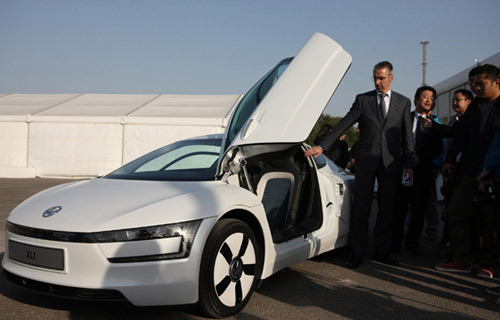 World's first 1-liter car debuts in Beijing
 Paper-made furniture lights up art show
 Robots kick off football match in Hefei
 Aerobatic team prepare for Aviation Convention
 China Suzhou Electronic Manufacturer Exposition kicks off
 'Squid beauty' and her profitable BBQ store
 A day in the life of a car model
 Vintage cars gather in downtown Beijing
Copyright 1995 - . All rights reserved. The content (including but not limited to text, photo, multimedia information, etc) published in this site belongs to China Daily Information Co (CDIC). Without written authorization from CDIC, such content shall not be republished or used in any form. Note: Browsers with 1024*768 or higher resolution are suggested for this site.
License for publishing multimedia online 0108263 Registration Number: 20100000002731