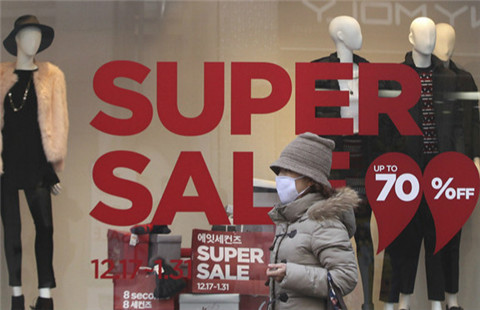
BEIJING - Chinese tourists have grabbed global attention for their frenzied shopping overseas in recent years, bringing home goods from designer outfits to quality life necessities, electric cookers for instance.
While domestic consumption is slack, enthusiasm for haitao (buying overseas goods online) is running high. The scenario is a perfect opportunity to explain "supply-side structural reform" in layman's term.
The current scenario is a result from a structural imbalance of domestic supply, meaning Chinese consumers can't find a supply of quality goods they particularly want.
Fixing the problem through reforms is the key to China's economy.
At a symposium attended by ministers and provincial officials on Monday, President Xi Jinping said supply-side structural reform will advance economic restructuring by reducing noneffective and low-end supply, and boost productivity by expanding medium-to-high-end supply.
Supply-side reform, a buzzword used by Chinese leaders and economists, focuses on better provisions for high-quality goods and services, lower costs for businesses and stronger consumption.
The phrase is created against the backdrop of a slowing economy. China's economy grew by 6.9 percent year on year in 2016, its slowest annual expansion in a quarter of a century.
However, a V-shaped rebound is beyond the reach of short-term stimulation. The root causes of the slowing economy must be addressed.
China has been transforming from an export- and investment-powered model to one based on stronger consumer spending, innovation and the service sector.
After decades of economic reform, the growth model and consumption demand have changed fundamentally, from a universal short of supply to oversupply in some sectors, and from an emphasis of quantity to a preference for quality.
The root cause of the slowing economy appears to be lack of consumption demand, but the actual cause is an imbalanced supply structure and mismatch between supply and demand.
That explains why China imports a large amount of fine steel, while crude steel domestically mass produced is priced "as cheap as cabbage", and the buying overseas frenzy against sluggish domestic consumption.
Future growth will rely on a balance between supply and demand, a requirement for adapting to the economic "new normal".
At present, the priority should be dissolving industrial overcapacity, phasing out "zombie enterprises", lowering business costs, developing strategic and emerging industries as well as service sectors, and expanding supply of public goods and services.
Statistically, China is accelerating its pace in optimizing economic structure.
For instance, the share of the value added of the service sector in the total GDP increased by 2.4 percentage points year on year in 2015.
The contribution of end-user consumption, including resident and government spending, to the national GDP growth in 2015 jumped by 15.4 percentage points from 2014, according to latest official data.
Moving in the same direction, the supply-side structural reform is expected to inject renewed vitality into Chinese economy.

Copyright 1995 - . All rights reserved. The content (including but not limited to text, photo, multimedia information, etc) published in this site belongs to China Daily Information Co (CDIC). Without written authorization from CDIC, such content shall not be republished or used in any form. Note: Browsers with 1024*768 or higher resolution are suggested for this site.
License for publishing multimedia online 0108263 Registration Number: 130349