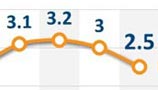
Besides the sharp decrease in the number of fish, some species, such as the finless porpoise, have already become extinct, said Zhao Yimin, head of the Yangtze River Fishery Resources Committee.
The plight along the river is not catching much public attention "as people can buy fresh fish from a wet market every day. They don't realize how serious the situation is", Zhao said.
"The source species are reducing, leading to unsustainable development of aquaculture and an increasingly fragile ecosystem."
Zhao said China's fishery resources will be drained soon if no immediate action is taken.
The report cited over-exploitation of hydropower and lax law enforcement as major reasons behind the dire situation.
On the Jinsha River, 25 hydropower plants are being, or will be built 100 km apart along the 2,308 km tributary of the Yangtze, according to the country's energy development plan.
Once completed, the plants will have power-generating capacity equivalent to four Three Gorges Dam projects.
"It will cut the river into sections, and completely change the aquatic environment, bringing a devastating impact to species and water quality," Zhao said.
According to environmental laws, a power plant has to pass an environmental impact assessment before construction starts. However, a majority of the projects go ahead without any assessment, Zhao said.
The environmental impact assessment for the Shuangjiangkou hydropower project, for instance, was passed two years after construction started in 2011.
Chen Jiakuan, a professor at Fudan University in Shanghai who participated in the research expedition, said that 450 million metric tons of sand flowed downstream in the Yangtze in the 1950s, compared to 150 million tons at present.
"The sand is silting up at reservoirs, leading to the degradation of water quality. It also changed the environment for fish," Chen said.
Hydroelectric power plants also change water temperatures and a river's flow, which damages native plants and animals in the river and on land, he said.
As for overfishing, experts said 100,000 tons of fish caught in the Yangtze is an amount beyond what its ecosystem could take.
An annual three-month moratorium during the fish spawning period on the Yangtze River is far from enough for fish reproduction, Zhao said.
"The best way is a total ban on fishing," he said.
But he said the policy is hard to implement as it involves a lot of issues such as compensating those who live on fishing.
He suggests establishing a department coordinating different interest groups to solve the problem.
"The department should be responsible for drafting compensation plans to ensure the fishing ban is effective."
As the Yangtze River basin covers 19 provinces and cities, accounting for 18.8 percent of the land area in China, saving the river and its fish resources is not an easy task.
New legislation is needed to raise public awareness, the report said.
Ren Wenwei, head of the Shanghai conservation program of WWF, said the current regulations are not enough.
"The Yangtze River Fishery Resources Committee is a vice-ministry level department, which has limited power to coordinate different interest groups," he said.
He and other scientists propose drafting a Yangtze River Basin Management Act and establishing a coordinating department directly under the State Council.


Copyright 1995 - . All rights reserved. The content (including but not limited to text, photo, multimedia information, etc) published in this site belongs to China Daily Information Co (CDIC). Without written authorization from CDIC, such content shall not be republished or used in any form. Note: Browsers with 1024*768 or higher resolution are suggested for this site.
License for publishing multimedia online 0108263 Registration Number: 130349