|
 |
|
Li Min / China Daily |
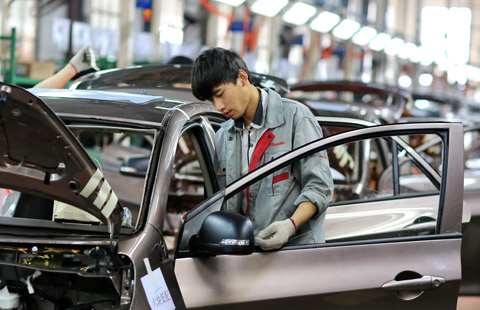
Some private enterprises are being driven overseas because of the increasing costs of doing business in China with rising wage costs and higher value of the Chinese yuan.
But of those interviewed in the report only 8.2 percent did it for costs reasons alone. Seeking out new markets (cited by 19.2 percent), building international marketing networks (16.6 percent) and becoming an internationally competitive global company (15.7 percent) were more important factors.
The report concludes that, in fact, many Chinese private firms have reached a "tipping point", at where "going out" is an effective way to upgrade and transform their business.
"Many Chinese enterprises have realized that outbound investment is not just a way to achieve geographical expansion or acquire natural resources. Once enterprises have reached a certain stage of development, outbound investment is a way to break through development bottlenecks," the report concludes.
Oliver M. Rui, professor of finance and accounting at China Europe International Business School in Shanghai, agrees with KPMG's findings and says that what is forcing them abroad is that their old business model no longer works.
"They can no longer just be OEM players producing low design, low margin goods because the domestic markets they serve now want brands and higher quality products."
He says that China has exceeded a per capita income of $8,000, which has been a global benchmark when consumers demand better products and services.
"In Shanghai and in other parts of eastern China that is now $20,000. That is why you see many companies from there looking to make acquisitions," he says.
"They are increasingly going to go out to Europe and the United States to acquire brands and research and development capability that will strengthen their position in their own markets."
According to Ministry of Commerce, private companies now account for up to 70 percent of ODI in some of China's more prosperous eastern provinces.
One province the KPMG report highlights is Jiangsu, which is seen as a hot bed of Chinese private companies stepping up their global efforts.
At the Economic and Technology Park at Yangshe, 60 km from the center of the province's major city Suzhou, Xu Weimin was an early pioneer of the efforts of Chinese companies to go overseas.
The 60-year-old is president of Jiangsu Dongdu Textile Group, which has a turnover of 8 billion yuan ($1.3 billion; 980 million euros) and 26,000 employees, 10,000 of which are located in Southeast Asia.
"If China's economy wants to develop to a higher level, Chinese companies need to speed up the pace of going international, which is becoming a necessary and vital step for every company," he says.
A former local state-owned enterprise, it began selling overseas in 1993 and is now one of China's top 50 exporting companies.
He insists that although a third of its garments are made overseas in Vietnam, Malaysia and, in particular Cambodia, any company setting up overseas operations to save costs would be misguided.
"People think going global will help solve problems such as labor shortage and rising labor costs. We had thoughts like that at the beginning but even 20 years later we haven't made those costs savings.


Copyright 1995 - . All rights reserved. The content (including but not limited to text, photo, multimedia information, etc) published in this site belongs to China Daily Information Co (CDIC). Without written authorization from CDIC, such content shall not be republished or used in any form. Note: Browsers with 1024*768 or higher resolution are suggested for this site.
License for publishing multimedia online 0108263 Registration Number: 130349