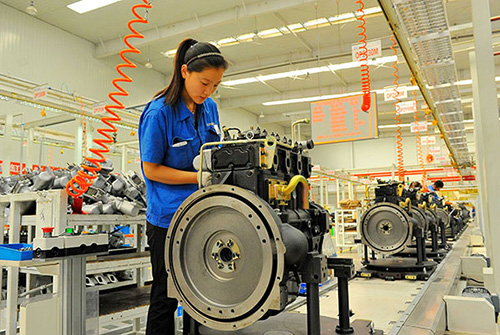
Industry experts say having both national and local standards would be unfeasible
An emissions plan proposed by the Beijing environmental authorities has been scrapped, a move that experts believe will save automakers from repetitive research and testing costs.
The city's draft, which was released in November for public opinion, has been aborted as the Ministry of Environmental Protection is working on national standards, said Wei Honglian, an official in charge of the vehicle emissions department at the ministry.
The Beijing plan was based on California's Low Emission Vehicle III standards, while national standards that have been adopted for decades in China follows the European standard.
Beijing's environmental authorities did not comment on the scrapped plan and a Beijing official advocating for local emissions standards turned down interview requests, according to Caixin magazine.
Despite much secrecy around the plan's abandonment, experts say one thing is clear - automakers will be heaving a sigh of relief.
If the Beijing plan went into effect, automakers would have had to prepare their cars to meet two sets of standards, which would entail a great deal of spending on research and development, said Cui Dongshu, secretary-general of the China Passenger Car Association.
"Chinese brands have a narrower profit margin and a stricter budget. To prevent cost hikes, they might have to wait until the national standards are implemented, but that will affect their supplies of vehicles to dealers and result in the shrinkage of the market share of Chinese cars."
Wu Jian, deputy head of GAC Automotive Engineering Institute, said the biggest problem resulting from two sets of standards mean automakers have to choose between two technical solutions.
"Because you cannot work out two solutions for one model. The cost is unreasonably high."
Cui said even if cars were able to meet two sets of standards at the same time, testing all cars available in the market twice would cost billions of yuan, resulting in "a huge waste of money".
Dong Yang, executive vice-president of the China Association of Automobile Manufacturers, said local emissions standards go against the interest of consumers.
He said the potential increase in R&D costs from multiple standards could have led to customers paying more to own a vehicle.
Dong is one of the earliest opponents of Beijing's local emissions plan.
"I agree with the stricter than current emissions standard applied in Beijing, but not Capital VI, as it is illegal," Dong wrote on his blog after the draft was released in November.
He said quality fuel supplies are vital to meeting emissions standards.
Cui also suggested that national standards should not be updated too often as it usually takes at least three years to develop a model.
The National V standards was implemented in April in 11 provinces and municipalities in eastern China and will not take effect nationwide until Jan 1, 2018.
"If the standards are implemented two years after they are finished, they will be able to better meet the requirements."
Some are demanding more time.
"If the authorities publicize the VI standards in 2016, they should not implement it before 2022," said Yan Ping, chairman of Yuchai, China's largest internal combustion engine producer.
lifusheng@chinadaily.com.cn

Copyright 1995 - . All rights reserved. The content (including but not limited to text, photo, multimedia information, etc) published in this site belongs to China Daily Information Co (CDIC). Without written authorization from CDIC, such content shall not be republished or used in any form. Note: Browsers with 1024*768 or higher resolution are suggested for this site.
License for publishing multimedia online 0108263 Registration Number: 20100000002731