CHINA> National

|
CHINA> National
|
|
New findings reported at terra-cotta army site
(Xinhua)
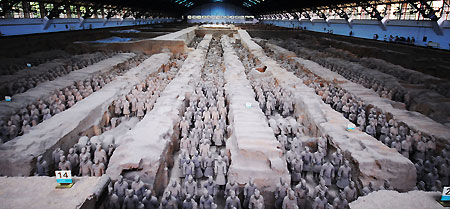
Updated: 2009-07-17 15:08 XI'AN: Archeologists have found up to 100 terra-cotta warriors and an army officer at the world heritage site in Xi'an, northwest China's Shaanxi Province, a month after they began a third excavation of the site. "Our most exciting discovery so far is the army officer," said chief archeologist Xu Weihong. He said the life-sized figure was found lying on its stomach behind four chariots. "We can't see its face yet, but the leather gallus on its back is distinct."
Xu said the gallus was typical of army officers in the Qin Dynasty (221 B.C.- 207 B.C.). "We need extra care to bring it out of the pit and restore its original color, which may take a few months." He said the figure was originally painted in different colors. "The original colors have faded after more than 2,000 years of decay, but a corner of the officer's robe suggested it was in colors other than the grayish clay."
Liu Zhancheng, head of the archeology arm of the Xi'an-based terra-cotta museum, estimated the year-long excavation would hopefully unearth about 150 terra-cotta warriors. Richly colored clay figures were unearthed from the mausoleum of Qinshihuang, the first emperor of a united China, in the previous two excavations, but once they were exposed to the air they began to lose their luster and turn an oxidized grey. The 230 by 62-meter No. 1 pit, which is currently under excavation, was believed to contain about 6,000 life-sized terra-cotta figures, more than 1,000 of which were found in previous excavations, said the museum's curator Wu Yongqi. The State Administration of Cultural Heritage approved the museum's dig of 200 square meters of the site, and the excavation is likely to continue if it proves fruitful. Most experts believe No. 1 pit, the largest of all three pits, houses a rectangular army of archers, infantrymen and charioteers that the emperor hoped would help him rule in the afterlife. The army was one of the greatest archeological finds of modern times. It was discovered in Lintong county, 35 km east of Xi'an, in 1974 by peasants who were digging a well. The first formal excavation of the site lasted for six years from 1978 to 1984 and produced 1,087 clay figures. A second excavation, in 1985, lasted a year and was cut short for technical reasons. The discovery, listed as a world heritage site by UNESCO in December 1987, has turned Xi'an into one of China's major tourist attractions. |
于田县| 西城区| 乌什县| 贺州市| 曲阜市| 黑龙江省| 客服| 通州区| 望江县| 景洪市| 嘉义县| 青川县| 邮箱| 翼城县| 五大连池市| 都兰县| 常宁市| 临西县| 马公市| 鄂伦春自治旗| 宜川县| 夏河县| 宁南县| 辉南县| 大石桥市| 黑龙江省| 永新县| 类乌齐县| 玉田县| 菏泽市| 平武县| 玉林市| 含山县| 建阳市| 长治市| 清镇市| 汶川县| 翁源县| 远安县| 四子王旗| 塔城市|