Society
Bottlenecks clog northern artery
By Jiang Xueqing and Cao Li in Beijing and Cheng Yingqi in Zhangjiakou (China Daily)
Updated: 2010-09-14 08:12
 |
Large Medium Small |
Covering costs
 |
|
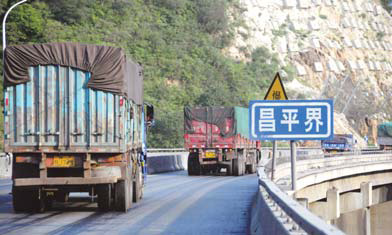
Heavy-duty trucks carrying coal supplies from mines in Shanxi province and Inner Mongolia autonomous region travel on the road to Beijing. [Provided to China Daily] |
With great demand for coal, transport companies are in fierce competition for business and, to save on costs, often overload their trucks, said Wang Dongming, a researcher at the NDRC's institute of comprehensive transportation.
Although the national standard fee recommended by the government is 0.5 yuan per ton per kilometer, freight firms often offer their services for just 0.3 yuan per ton per kilometer to win more contracts.
The cut-price rate means they need to ship more cargo using the shortest route.
Dong Shunsheng, a truck driver from Inner Mongolia who has been transporting coal for more than a year, said the Beijing-Tibet Expressway is the most convenient and cost-efficient route.
One alternative, National Highway 110, which is a two-way dual carriageway full of bumps where trucks stop constantly, has been under construction during the recent congestion problems. Another, National Highway 208, is an extra 200 kilometers and 33 percent more expensive, he said.
"Each extra kilometer adds at least 3 yuan to your costs, such as fuel and road tolls," said Jia Wensheng, 44, who drives a China Post van. "Drivers would rather waste time than money if they are not in a hurry."
National Highway 208 also passes through a coal quality supervision and inspection station in Datong, Shanxi province, where trucks are stopped and checked. As most are overloaded or do not have the right paperwork to carry coal, they avoid it and instead use the Beijing-Tibet Expressway.
"I pay 1,300 yuan for fuel, roughly 1,000 yuan in toll fees and about 600 yuan in other expenses," said Luo Jun, who transported coal from Hohhot to Shangyi county in Hebei. "If I carried only the 26 tons my truck is allowed to, the trip wouldn't even cover my costs."
Although companies argue overloading is unavoidable if they want to make a profit, experts say it is dangerous and seriously affects roads and traffic flow.
While the average speed on highways is 110 kilometers per hour, studies show that overloaded trucks can only travel at a maximum of 50 km/h, said researcher Wang.
To curb the rampant problem, Beijing police in August imposed restrictions on heavy-duty trucks using the city's expressways during the day. Other authorities have also set up checkpoints to catch offenders.
However, this involves truck drivers lining up to have cargo being unloaded and weighed, which some say contributes to the slow traffic.
The number of toll gates is also large, added Wang. Highways are managed by various provinces, which use the money collected to maintain the roads or building new ones.
Although he advocated for the reduction in tolls, Wang urged the government to create laws that ensure investment and maintenance of highways.
"At places where toll gates have been removed, the roads have really deteriorated," he added.