Known as one of the country's "three furnaces", Wuhan has been drawing nationwide attention to its efforts to lower temperatures and curb pollution by connecting to the environment.
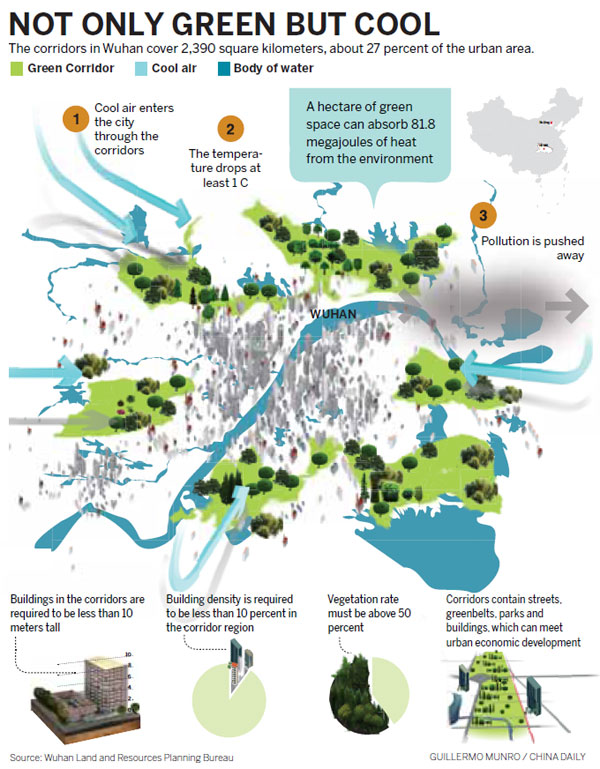
Urban planners in the capital of Hubei province have been working on a plan to direct airflows into the city through six green corridors connected to six nearby lakes.
The project targets a temperature reduction of at least 1 C in the city's downtown areas during summer. Many other Chinese cities that are plagued by heatwaves and smog are watching closely to see if the move can be duplicated.
"Large cities like Beijing are more and more frequently covered by smog, mainly due to still air conditions, and building green corridors to let breeze flow through can alleviate the issue," said Xu Hao, dean of the College of Resources and Environment Science at the Agricultural University of Hebei.
Urban planning authorities in Hangzhou, Zhejiang province, and Nanjing, Jiangsu province, have also launched studies in building such corridors to ease air pollution.
Yu Zhuang, a professor at the School of Architecture and Urban Planning at Wuhan's Huazhong University of Science and Technology, said that the Wuhan model is "successful" in lowering temperatures and fighting pollution, but he added that not all cities might be able to apply the same method.
"Wuhan is surrounded by lakes, which are crucial in wind flowing from water to land, but the model might not be successfully duplicated in Beijing, with mountains on three sides," Yu said.
Still, many believe that for cities along the Yangtze River, Wuhan sets an example.
Chongqing and Nanjing, both situated along the Yangtze, are the other two "furnaces" of China that have oppressively hot and humid summers.
The green corridors in Wuhan cover 2,390 square kilometers, about 27 percent of its urban area. Building density is required to be less than 10 percent in the corridor region.
Buildings in the corridors must also be less than 10 meters tall and the vegetation rate must be above 50 percent, according to the city's land resources and planning bureau.
Corridors contain streets, greenbelts, parks and buildings, which can also meet urban economic development, authorities said.
"In this way, the 'urban heat island effect' can be alleviated with cooling temperatures and more fresh air will help blow air pollution away," said Chen Zhixiong, a senior engineer with infrastructure planning and design office under the Wuhan Planning and Design Institute.
The urban heat island effect refers to higher temperatures in the city center compared with suburban or rural areas.
Contact the writers at wangqian@chinadaily.com.cn and liukun@chinadaily.com.cn


Copyright 1995 - . All rights reserved. The content (including but not limited to text, photo, multimedia information, etc) published in this site belongs to China Daily Information Co (CDIC). Without written authorization from CDIC, such content shall not be republished or used in any form. Note: Browsers with 1024*768 or higher resolution are suggested for this site.
License for publishing multimedia online 0108263 Registration Number: 130349 



