|
|
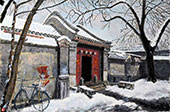
Zhang Xiaoyou's jiehua painting Old Days of Southern River Towns captures details of a night scene in a typical river town of southern China.[Photo provided to China Daily] |
In 1940s' Shanghai, a 5-year-old was the only boy studying at a Catholic girls' primary school in the French Concession.
His parents then felt their thin and weak son would be better taken care of by the nuns. He was also watched over by his teenage cousin, who also attended the school.
The boy, Zhang Xiaoyou, learned how to stitch and often received European postcards as rewards for his work. After school, he liked to browse through picture books at street stands. He loved visiting the nearby St. Peter's Catholic Church, a 1930s Byzantine-style structure, where music from the imposing pipe organ and the murals sparked his interest in art.
"My family hoped that when I grew up I would become an architect or a doctor," he says.
But Zhang ended up choosing painting as a career. Since his retirement from Tsinghua University's academy of arts and design in the late 1980s, Zhang, now 81, has specialized in reviving the dying art of jiehua, or boundary painting.
Jiehua evolved as an important part of Chinese ink-and-wash painting during the Sui (AD 581-618) and Tang (AD 618-907) dynasties. But as it primarily depicted architecture, vessels and vehicles, painters were required to be accurate, proportional and meticulous in their illustrations.
They were also allowed to draw lines using rulers. But they needed to master brushwork just like in gongbi (meticulous brushwork) painting.
Jiehua provides a visual treat and was useful when producing blueprints for pavilions, terraces and towers. For that reason, the painting style was earlier seen as being too industrial and not artistic enough when compared to the more abstract and elevated shanshui (mountain-and-water) style.
But with Zhang's works, one understands how he is working to change that perception, and breathe new life into the jiehua genre.
His paintings are now on display, along with the works of former colleagues at Tsinghua University, at the Shaoxing Art Museum in Shaoxing, Zhejiang province, through Aug 31.
Among the works are Old Days of Southern River Towns, a 4-meter-long scroll on silk that captures a night scene in a typical river town of southern China in the late Qing Dynasty (1644-1911).
With his attention to detail, Zhang juxtaposes various architectural forms-including gate towers, arches, roofed bridges, pavilions with open halls and pagodas.

|
|
|
|
|
|
|
|

Copyright 1995 - . All rights reserved. The content (including but not limited to text, photo, multimedia information, etc) published in this site belongs to China Daily Information Co (CDIC). Without written authorization from CDIC, such content shall not be republished or used in any form. Note: Browsers with 1024*768 or higher resolution are suggested for this site.
License for publishing multimedia online 0108263 Registration Number: 130349 



















 Raymond Zhou:
 Pauline D Loh:
 Hot Pot
 Eco China
 China Dream
 China Face