Xinjiang silk seeks a broader fashion stage


 |
|
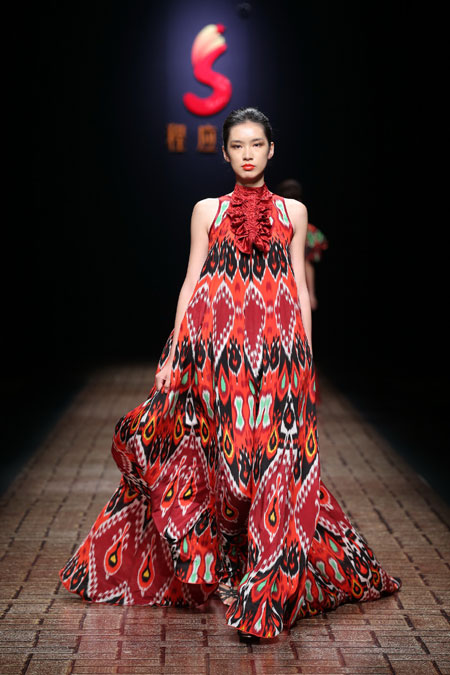
Models display designer Cheng Yingfen's 2015 spring/summer collection, which highlights Idili silk, in Beijing. [Photo/China Daily] |
Idili silk has so far not attracted many fans outside of Xinjiang. To promote it on a larger scale, Cheng filtered the traditional patterns and palette with an eye to international fashion trends and developed new patterns. She then worked with local artisans to weave the new patterns onto the fabric.
When local clients saw the results, at first they didn't even recognize it as a traditional Xinjiang fabric, Cheng recalls.
"The style is modern, but if you look close enough, you can still see the traditional touch there. The patterns and colors all come from the old days," Cheng says.
The company is planning to mass-produce Idili silk using a printing technique rather than hand-weaving so the colors won't fade as easily and the fabric will be available to more people.
The clothes are now sold in Xinjiang, as well as China's neighboring Central Asian countries like Kazakhstan and Uzbekistan.
Zhao hopes that a wider appreciation of Idili silk will not only help revive the fabric but also help create more jobs in the area.
"We are building more than a brand. It's also cultural heritage. If there is no guidance, few people will continue making Idili silk. If we can promote it successfully, the brand will get stronger and more people will participate in the industry," she says.
The workers need only one to three months' training to work in the garment factories, she adds.
The initiative is also part of the government's plan to boost employment in Xinjiang, she says.
The country plans to invest 20 billion yuan ($3.2 billion) in the apparel industry in the region and raise the employment capacity to 1 million by 2020, media report. Xinjiang produces more than half of China's cotton.