|
MY friends and I headed to Anhui province last spring to climb the Yellow Mountain. As a tie-in trip we also headed to the neighboring Qiyun Mountain, a Taoist holy site.
Qiyun Mountain is most often mentioned as a footnote to the Yellow Mountain, which is one of China's 'big five' mountains. But it turns out that Qiyun Mountain is no less impressive than its famous brother in terms of both natural scenery and cultural significance.
The two mountains are close to each other – a distance of mere 50 kilometers. Both fall within the territory of Huangshan city. Qiyun in Chinese means 'as high as the clouds', though the mountain doesn't really live up to its name – it reaches a modest 585 meters above sea level.
The appellation is not entirely baseless, however. For much of the year the mountain's 36 craggy peaks are shrouded in a sea of clouds and a dense veil of mist in the morning. The clouds, it seems, descend from the heavens to fulfill the promise of the mountain's name.
Perhaps the almost constant cloud cover and the sense of seclusion it creates explain why Qiyun Mountain has remained an epicenter of Taoism in South China for over a millennium. China's history over the past several hundred years has been tumultuous, but this hasn't stopped Taoist followers from making pilgrimages to the mountaintop shrine of Lord Zhenwu, the Truly Martial Grand Emperor. Dynasties fell and wars raged, but artists, scholars and poets continued the Taoist tradition of immersing themselves in the serene solace of the woods above Qiyun’s steep bluffs. Some have left behind works of art to mark their stay in the form of inscribed tablets. The carvings of sages long past remain on the rock face today, standing stately guard over tourists who clamber up Qiyun.
 |
|
Cliff carvings on Qiyun Mountain have religious, literary and philosophical significance.
|
Land of Immortals
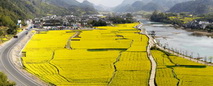
Qiyun Mountain sits on the bank of the Shuaishui River which, viewed from the mountaintop, meanders along picturesquely by grain fields and white-walled cottages. The river and its polychrome surrounds are said to closely resemble a black and white Yin and Yang sign – or the 'diagram of the supreme and ultimate' to use its real name – when viewed from directly above. Proximity to such powerful Taoist imagery is the reason why Taoist sage Zhang Sanfeng is said to have spent his last years on the mountain before gaining immortality. Thanks to the power of the Tao, Zhang had a long life. According to legend, he lived 200 years from 1247 to 1458.
|