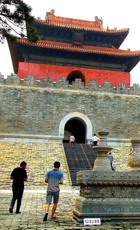
The State Administration of Cultural Heritage and Historic Scotland — the Scottish government's heritage agency — has announced a digital preservation project for the Eastern Royal Tombs of the Qing Dynasty (1644-1911).
The project will present to the world the largest and best-preserved mausoleum of China's last empire in 3D.
The Royal Tombs project is included in the Scottish Ten Project, a five-year international 3D scanning project to digitally document Scotland's five World Heritage Sites, as well as five international sites. The Chinese project follows similar ones at the Mount Rushmore National Memorial in the United States and at the Rani ki Vav Stepwell in India.
In use from 1666 to 1911, the Eastern Qing Tombs in Hebei province's Zunhua were the final resting place of some of the Qing Dynasty's best-known emperors and empresses, including Emperor Qianlong (1711-1799) and Empress Dowager Cixi (1835-1908).
In 2000, the tombs were classified as a World Heritage Site by the UNESCO, and described as a "masterpiece of human creative genius".
The project's technical team — which comprises experts from Historic Scotland and the Digital Design Studio at the Glasgow School of Art — will use new 3D technologies, such as mobile laser scanners, to digitally survey all the structures and features of the site.
The project will focus on the Xiaoling Mausoleum of Emperor Shunzhi (1638-1661) and the Jingling Mausoleum of Emperor Kangxi (1654-1722). Shunzhi was the first Qing emperor that ruled all over China. Kangxi, his son, ruled for 61 years, longer than any other emperors in Chinese history.
"Our main challenge is the scale of the site. Previous projects usually took two weeks each, while the time to record the Eastern Qing Tombs will double," said Lyn Wilson, manager of Scottish Ten Project.
The work is about 20 percent completed, she added. In four weeks, the team will have recorded the whole site and will create a precise digital map of the Xiaoling Mausoleum and the Jingling Mausoleum.
The results will be available to support ongoing conservation programs, and to provide educational and virtual tourism tools.
"Scotland and China share a passion for heritage. We are both proud nations and heritage is an important part of our cultural identities," said Wilson.
"This preservation project is a digital form of diplomacy between China and Scotland," said Zhang Heqing, deputy inspector of the Foreign Affairs Department of the State Administration of Cultural Heritage.
"The Eastern Qing Tombs don't only belong to China, but to the whole world. We'll do everything we can to cooperate with the Scottish experts to show our heritage to the world," said Su Guangjun, deputy director of the Administrative Committee of the Eastern Royal Tombs of the Qing Dynasty. |