 |
|
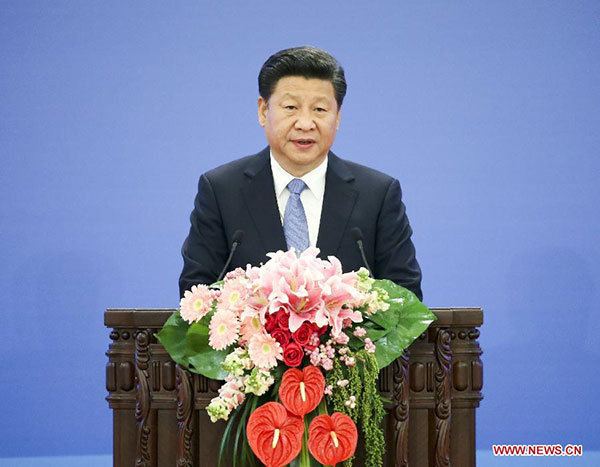
Chinese President Xi Jinping addresses the 2015 Global Poverty Reduction and Development Forum in Beijing, capital of China, Oct 16, 2015. [Photo/Xinhua] |
China has an unmatched record of achievement in poverty reduction over the past three and a half decades - accounting for 72 percent of the global reduction in extreme poverty. Last month, at the United Nations General Assembly, President Xi Jinping reiterated China's ambitious targets to further reduce poverty, as 7 percent of the developing world's poor still live in China today.
China's success in poverty reduction is the result of a combination of factors, including strong economic growth, attention to antipoverty programs, and improved access to social services and social protection. Establishing a comprehensive social protection system has been key for China's successful poverty reduction. The Dibao program, which provides cash to China's needy, is the backbone of the system. It is also the largest program of its kind in the world.
It is thus no coincidence that this week almost 250 participants from 75 countries are in Beijing to discuss social protection in an urbanizing world and to learn from China's success and more about its remaining challenges. The event offers an opportunity to discuss the role of social protection in urban areas - a dynamic and catalytic role that bolsters upward mobility through better access to safety nets, housing and jobs tailored to urban settings.
The Urban Dibao program was piloted in 1993 and expanded to all cities in China in 1999. By 2003, the program covered some 22 million urban residents. Workers laid off from State-owned enterprises and the unemployed accounted for over two-fifths of the program's beneficiaries. Studies documented how the Urban Dibao program cushioned the effects of China's SOE reforms on workers. Today, the focus of the Urban Dibao program has shifted to the elderly living in poverty, the working poor and low-income families with adult members with low skills, disabled or without a support network.
The Rural Dibao program was adopted nationwide in 2007, following years of piloting. The program has been scaled up from 36 million to 52 million beneficiaries between 2007 and today. The government's budget for the Rural Dibao program has increased dramatically, from 4 billion yuan ($629.08 million) in 2007 to 87 billion yuan in 2015, with the central government covering the majority of financing since 2009. This has allowed a five-fold increase in the average transfer amount to families, along with the vast expansion in coverage.



I’ve lived in China for quite a considerable time including my graduate school years, travelled and worked in a few cities and still choose my destination taking into consideration the density of smog or PM2.5 particulate matter in the region.
Copyright 1995 - . All rights reserved. The content (including but not limited to text, photo, multimedia information, etc) published in this site belongs to China Daily Information Co (CDIC). Without written authorization from CDIC, such content shall not be republished or used in any form. Note: Browsers with 1024*768 or higher resolution are suggested for this site.
License for publishing multimedia online 0108263 Registration Number: 130349 



