 |
|
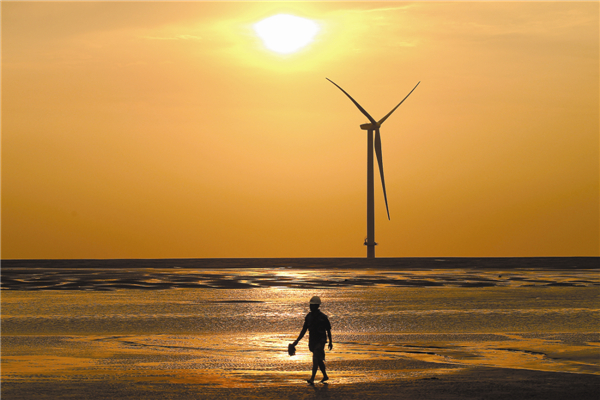
A wind farm at Rudong in Jiangsu province. China's installed wind power capacity had reached almost 63 million kilowatts by the end of 2012. [Photo by Xu Congjun / for China Daily] |
World leaders will meet in Paris to negotiate a new climate change agreement. To date, 150 countries have submitted plans detailing how they will move their economies along a more resilient low-carbon trajectory. These plans represent the first generation of investments to be made in order to build a competitive future without the dangerous levels of carbon dioxide emissions that are now driving global warming.
The transition to a cleaner future will require both government action and the right incentives for the private sector. At the center should be a strong public policy that puts a price on carbon pollution. Placing a higher price on carbon-based fuels, electricity and industrial activities will create incentives for the use of cleaner fuels, save energy and promote a shift to greener investments. Measures such as carbon taxes and fees, emissions-trading programs and other pricing mechanisms, as well as removal of inefficient subsidies can give businesses and households the certainty and predictability they need to make long-term investments in climate-smart development.
At the International Monetary Fund, the focus is on reforming its member countries' fiscal systems in order to raise more revenue from taxes on carbon-intensive fuels and less revenue from other taxes that are detrimental to economic performance, such as taxes on labor and capital. Pricing carbon can be about smarter, more efficient tax systems, rather than higher taxes.
Carbon taxes should be applied comprehensively to emissions from fossil fuels. The price must be high enough to achieve ambitious environmental goals in alignment with national circumstances, and it must be stable, in order to encourage businesses and households to invest in clean technologies. Administering carbon taxes is straightforward and can build on existing road fuel taxes, which are well established in most countries.
Carbon pricing will be in many countries' best interests, owing to the many domestic environmental benefits. For example, burning cleaner fuels helps reduce outdoor air pollution, which, according to the World Health Organization, currently causes about 3.7 million premature deaths a year.
It is important to address the impact of energy-price reforms on vulnerable groups in every society. So these reforms will need to be accompanied by adjustments to fiscal systems and safety nets, among other things, to ensure that the poor are not harmed.



I’ve lived in China for quite a considerable time including my graduate school years, travelled and worked in a few cities and still choose my destination taking into consideration the density of smog or PM2.5 particulate matter in the region.
Copyright 1995 - . All rights reserved. The content (including but not limited to text, photo, multimedia information, etc) published in this site belongs to China Daily Information Co (CDIC). Without written authorization from CDIC, such content shall not be republished or used in any form. Note: Browsers with 1024*768 or higher resolution are suggested for this site.
License for publishing multimedia online 0108263 Registration Number: 130349 



