 |
|
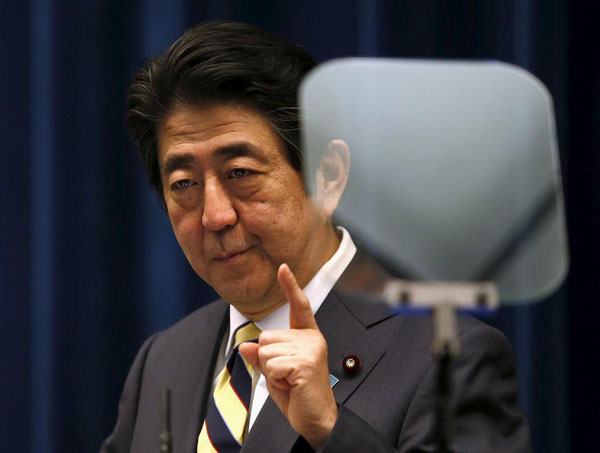
Japan's Prime Minister Shinzo Abe addresses reporters on the first official business day of the New Year during a news conference at his official residence in Tokyo, Japan, January 4, 2016. [Photo/Agencies] |
Japan has agreed to pay 1 billion yen ($8.3 million) to help the Republic of Korea set up a fund to support Korean women forced into sexual slavery by the Japanese army before and during World War II, in order to settle the "comfort women" issue.
Later, during his talks with ROK President Park Geun-hye over the phone, Japanese Prime Minister Shinzo Abe said the deal was "final and irreversible" and rendered apology to the Korean women who were forcibly "recruited" as sex slaves. Park, on her part, said she expected the agreement to help develop bilateral relations in a stable manner with an eye to the future.
For many, it is surprising to see the sudden settlement of the sore point in Tokyo-Seoul relations, although some uncertainties remain. To begin with, the deal is actually a compromise between Japan and the ROK in which the United States seems to have played a vital role. US Secretary of State John Kerry welcomed the agreement on the very day it was announced, saying it "will promote healing and help to improve relations between two of the US' most important allies". Applauding the leaders of the two countries "for having the courage and vision to reach this agreement", he even urged the international community to support it.
Apparently, the last thing Washington wants to see is its "pivot to Asia" falling apart because of the widening fissures between its allies in East Asia, and this could explain its consistent intervention in Japan-ROK bilateral affairs.
Failing to make progress in some longstanding territorial disputes and convince its neighbors of its "sincere" remorse over its war crimes, Japan had been caught in a diplomatic stalemate and was thus desperate to seek a diplomatic breakthrough. As much as Abe hates to admit, reconciling with the ROK was a decision he was forced to make because his extensive diplomatic maneuvers over the past two years had not been able to end its "neighborhood dilemma".



I’ve lived in China for quite a considerable time including my graduate school years, travelled and worked in a few cities and still choose my destination taking into consideration the density of smog or PM2.5 particulate matter in the region.
Copyright 1995 - . All rights reserved. The content (including but not limited to text, photo, multimedia information, etc) published in this site belongs to China Daily Information Co (CDIC). Without written authorization from CDIC, such content shall not be republished or used in any form. Note: Browsers with 1024*768 or higher resolution are suggested for this site.
License for publishing multimedia online 0108263 Registration Number: 130349 



